
TL;DR
When migrating from one CMS to another, it’s important to consider Contentful’s pricing, which may vary. This guide compares each plan based on actual team sizes and highlights hidden costs not reflected in the main pricing. Additionally, it benchmarks Contentful against leading headless CMS platforms like Sanity, Storyblok, Payload, and Strapi. This way, you can clearly see if you’re getting value or just spending.
Contentful enterprise pricing rose 30% year-over-year, and this is the steepest increase in the headless CMS category. Total cost of ownership typically runs 40–60% above list price once API overages, additional Spaces, and implementation are factored in.
Contentful Pricing Plans in 2026: What You Actually Get
If you’ve ever tried to figure out what Contentful actually costs, you already know the problem: the pricing page is vague, the jump from free to paid is brutal, and the bill at the end of the year rarely matches what you expected when you signed up.
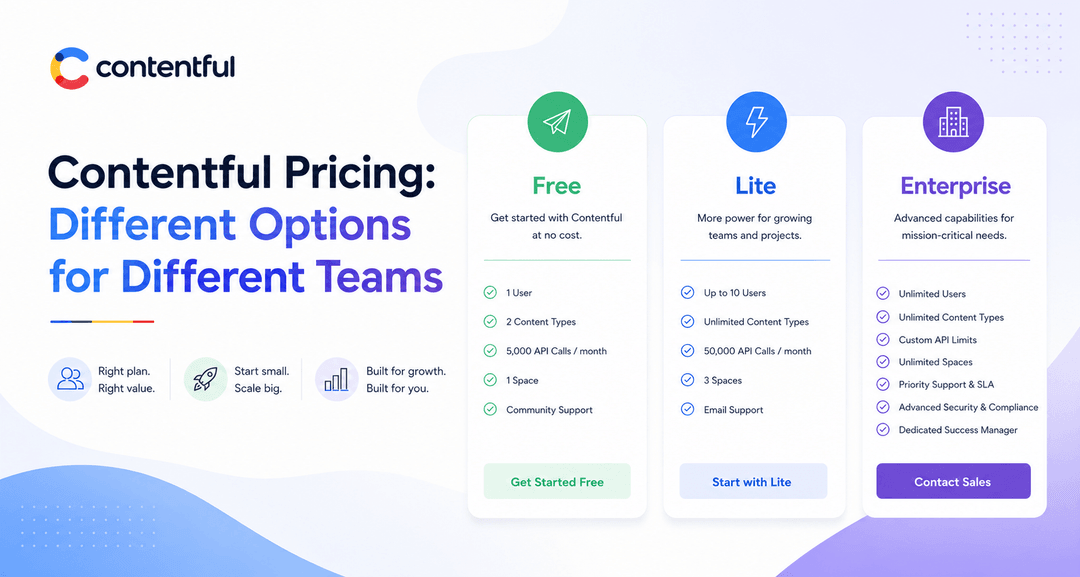
Contentful currently offers three tiers: Free, Lite (also referred to as Basic in some third-party listings), and Premium (custom, enterprise-facing).
Free Plan: $0/month
The Free plan is Contentful’s developer sandbox. It includes:
- Up to 10 users
- 1 Space (environment)
- 100K API calls/month, 50 GB CDN bandwidth (no overages)
- 2 locales
- Rich text editor, image editor, live preview, tasks, comments
The key limitation: no overages allowed, and the API call ceiling is low enough that any production site with meaningful traffic will hit it. The plan is sufficient for prototyping, testing, or a personal portfolio — not for running a client site or a growing product.
Lite Plan: ~$300–$850/month
This is where Contentful gets complicated. Published pricing varies significantly across sources — third-party trackers cite figures ranging from $300/month to $850/month, depending on billing cycle and plan configuration.
At the time of writing, the most commonly cited entry-level paid price is around $300/month billed annually, with monthly billing pushing it higher.
The Lite plan includes:
- Up to 20 users
- 1M API calls/month, 100 GB CDN bandwidth
- Multiple environments
- Basic roles and permissions
The hard truth: there is no middle ground between Free and Lite plans. Teams that outgrow the free tier face an immediate jump of $3,600/year minimum with no graduated option. Multiple users on TrustRadius and Reddit cite this cliff as a key frustration — “there is no way to step up from free gracefully over time.”
Premium Plan: Custom pricing (contact sales)
Premium is Contentful’s enterprise product.
Key additions include:
- Unlimited API calls (though asset bandwidth overages still apply at $65/TB)
- SSO, custom roles, advanced security, PCI DSS compliance
- Customer Success, Professional Services, 24/7 support
- Custom contract, SLA, and data residency options
What does it actually cost? Based on anonymized contract data from procurement platforms:
- SMB average: ~$36,800/year
- Enterprise median: ~$64,300/year
- Enterprise average: ~$179,000/year
Enterprise pricing increased 30% year-over-year between 2024 and 2025, according to SpendHound’s contract dataset, the sharpest increase in the CMS category.
The Hidden Cost Problem
The headline price is just the beginning. Contentful’s total cost of ownership typically runs 40–60% above the list price once you account for:
1. API Overage Fees
API calls scale with traffic, content updates, and the number of preview environments your team runs. High-traffic sites or teams with aggressive editorial workflows: lots of draft saves, webhook triggers, and live preview refreshes, burn through API quotas fast. Overage charges are not prominently disclosed on the pricing page.
2. Additional Spaces
Each Space (environment) in Contentful is billed separately. Multi-brand, multi-market, or multi-tenant architectures where you’d naturally want isolated environments per client or region can multiply your bill quickly.
3. Seat Costs at Scale
While the Lite plan has a user ceiling of 20, larger teams either pay for Premium or find workarounds. Moving from 10 to 50 users at scale is not a linear cost, it requires jumping to a negotiated Premium contract.
4. Implementation and Migration
Contentful is not a plug-and-play CMS. Professional services, developer time for content modelling, custom field setup, and migration from legacy systems add real cost. For mid-market teams, first-year implementation overhead often exceeds the subscription cost.
5. Integrations and Add-ons
Contentful’s App Framework and Marketplace integrations — localization services, DAMs, e-commerce connectors — frequently carry their fees on top of your Contentful plan.
Real Cost by Team Size and Use Case
| Scenario | Team Size | Est. Annual Cost | Notes |
|---|---|---|---|
| Developer prototyping / portfolio | 1 | $0 | Free tier is sufficient |
| Small marketing site | 2–5 editors | $0 | Free tier workable if low traffic |
| Growing SaaS product | 5–15 | $3,600–$10,200/yr | Lite plan; watch API limits |
| Agency managing 3–5 client sites | 10–20 | $10,200–$36,000/yr | Multiple Spaces multiply cost |
| Mid-market digital team | 20–50 | $36,000–$80,000/yr | Premium required; negotiation needed |
| Enterprise, multi-locale | 50+ | $100,000–$200,000+/yr | Full Premium; custom SLA and services |
Contentful vs. Competitors: Pricing Comparison 2026
Here’s how Contentful stacks up against the leading headless CMS platforms on price, model, and fit.
| CMS | Starting Price | Pricing Model | Self-Hosted | Best For |
|---|---|---|---|---|
| Contentful | $0 / $300–$850/mo | Per-space + usage | No | Enterprise teams, compliance-heavy orgs |
| Sanity | $0 / $15/seat/mo | Per-seat + usage | No (Studio only) | Developer-first teams, complex content models |
| Storyblok | $0 / ~$90/mo | Per-seat + traffic | No | Marketing teams, visual editing |
| Hygraph | $0 / $299+/mo | Per-seat + API calls | No | GraphQL-native, content federation |
| Strapi | Free (self-host) / $29/mo cloud | Open source | Yes | Full data ownership, no SaaS fees |
| Payload CMS | Free (MIT) / $35/mo cloud | Open source | Yes | Next.js-native teams, TypeScript stacks |
| Prismic | $0 / custom | Per-seat + slices | No | Marketing sites, Slice Machine workflow |
Contentful vs. Sanity
This is the most common comparison at the mid-market level. Sanity’s Growth plan starts at $15/seat/month, making it dramatically cheaper than Contentful for teams of 5–20. Sanity’s free tier is also more production-viable: 20 users, unlimited locales, generous API limits.
Where Contentful wins: the out-of-the-box editorial UI is more polished and approachable for non-technical editors. Contentful has a larger enterprise ecosystem and more established compliance certifications. If your editorial team is non-technical and you’re in a regulated industry, Contentful’s premium may be justified.
Where Sanity wins: schema-as-code, GROQ queries, Portable Text, and real-time collaboration give developers far more flexibility. For teams that treat content structure as a product discipline, Sanity rewards investment. At comparable functionality, Sanity typically costs 60–80% less than Contentful.
Contentful vs. Storyblok
Storyblok’s visual block editor is genuinely excellent for marketing teams that need to build and edit pages without developer involvement. Entry pricing is lower, and the interface is more intuitive for editors. However, Storyblok’s architectural model starts to push back when content models grow complex, it’s optimised for marketing site patterns, not structured content at scale.
Contentful vs. Payload CMS
Payload is MIT-licensed and free forever. You pay hosting costs only (or ~$35/month on Payload Cloud). For Next.js-native teams, Payload runs as a local API inside your application — no external service, no API latency, no per-seat billing. The trade-off is operational overhead: you own the infrastructure, maintenance, and security.
For a team already running on Vercel and Next.js, Payload can reduce CMS spend from $36,000+/year to under $1,000/year in hosting costs. The catch is developer time to set up and maintain.
Contentful vs. Strapi
Strapi is the open-source default for teams that want a CMS with a built-in admin UI and full data ownership. No API call limits, no seat restrictions, no SaaS vendor dependency. Like Payload, you pay hosting, but Strapi Cloud plans start at $29/month if you want managed hosting.
How Teams Are Reducing Their Contentful Bill in 2026
If you’re already on Contentful CMS and want to stay there, here are the main tips to control costs:
1. Negotiate in Q4. Contentful’s fiscal year ends in December. Sales teams are incentivized to close deals before year-end. Buyers who demonstrate competitive alternatives (Sanity, Storyblok) during Q4 negotiations consistently report discounts.
2. Audit your Spaces. Many teams accumulate redundant Spaces for staging, testing, and archived projects. Each adds to your bill. Consolidate environments using Contentful’s built-in environments feature within a single Space rather than creating new Spaces.
3. Cache aggressively. A significant portion of API overage costs comes from uncached or poorly cached delivery requests. Implementing proper CDN caching at the Vercel, Cloudflare, or Fastly layer dramatically reduces CDA call volume.
4. Audit seat usage. Review whether all licensed users are active. On annual contracts, removing unused seats is one of the cleanest ways to reduce cost without changing your stack.
5. Use the Content Delivery API, not the Management API, for reads. CDA calls are cheaper. Teams that use CMA for content previews or build pipelines burn quotas faster than necessary.
6. Negotiate usage limits upfront, not after. Overages are expensive and opaque. Locking in higher usage ceilings as part of your contract negotiation, before you sign, is far more effective than disputing overage invoices after the fact.
7. Consider a hybrid architecture. Some teams keep Contentful for content types that benefit from its editorial UI (marketing pages, localized copy) and move high-volume, structured data (product catalogues, pricing tables) to a purpose-built data layer like Supabase. This reduces API call volume without abandoning the platform.
When Contentful Is Not the Right Choice
Contentful is a mature, capable platform, but it’s built for a specific profile of buyer. If your team doesn’t match that profile, you’re paying a premium for features and overhead you won’t use.
Contentful is probably not the right fit if:
1. You’re a developer-led team comfortable managing infrastructure. Open-source alternatives like Payload CMS or Strapi give you equivalent—often greater—flexibility discounted the cost. The SaaS convenience Contentful charges for is a cost centre if your team doesn’t need it. 2. Your team is under 20 users with no compliance requirements. The Free-to-Lite pricing cliff means you’ll pay $3,600/year minimum the moment you outgrow the sandbox. Without compliance drivers or enterprise governance requires, that jump is challenging to justify against alternatives with more graduated pricing. 3. You’re an agency billing CMS costs per client. Contentful’s per-Space model means your bill scales with every new client environment. Agencies managing multiple client sites routinely find that per-client CMS costs make Contentful economically unworkable unless costs are passed through at a significant markup. 4. You’re building on Next.js and want CMS-as-code rather than CMS-as-service. Payload runs as a local API inside your Next.js application — no external dependency, no API latency, no per-seat billing. If your team treats content structure as a code-owned discipline, Contentful’s editorial-first architecture works against you. 5. Cost per outcome matters more than editorial polish. Contentful’s interface is genuinely excellent for non-technical editors. If your editors are technical, or if your primary concern is delivery performance and cost efficiency rather than editorial experience, you’re paying for polish your team won’t notice.
The alternative: if one or more of the above applies, the comparison section above maps the most relevant alternatives to your specific situation.
Bottom Line
Contentful built its reputation on enterprise reliability, a polished editorial interface, and a mature API ecosystem. That reputation is real and so is the price tag.
In 2026, the platform makes most sense for large organisations with complex compliance requirements, sophisticated personalisation at scale, and editorial teams that benefit from its opinionated, accessible interface.
For everyone else, developer-led teams, agencies, startups, and mid-market companies that care about cost per outcome, the gap between Contentful and competitors like Sanity, Storyblok, and Payload has never been wider. At comparable feature sets, teams are paying 2-5x more to stay on Contentful than they would on the nearest alternative.
The question isn’t whether Contentful is good. The question is whether it’s the right tool for your scale, your team, and your budget in 2026, and whether the premium you’re paying is buying you capabilities you actually use.
If you need an expert team specialized in Contentful migration, don’t hesitate to reach out to our engineers to assess your current situation and get your website migration plan.





 Eugene Boruhov