
This article is part of our series on the leading headless CMS platforms for developers and digital agencies, focusing on Contentful’s use cases, capabilities, advantages, and limitations.
What Is Contentful CMS?
Contentful is a widely adopted headless content management system for enterprise and multi-channel digital experiences. Brands including BMW, Nike, and Cloudflare use Contentful to manage structured content across websites, applications, and other digital channels.
Contentful separates content management from the frontend, giving development teams control over how content is delivered while allowing editors to manage structured content independently.
This guide covers what Contentful offers, where it fits best, how its pricing works, and when another CMS may be a better fit.
Who Uses Contentful?
Many influential global brands and big‑tech companies use Contentful as their content management system
BMW rebuilt its global web presence on Contentful, centralizing content operations across regions while giving local markets the flexibility to adapt messaging without compromising brand consistency.
Nike uses Contentful to power in-store interactive experiences and digital activations: use cases that demand reliable, high-performance content delivery to non-browser environments.
Cloudflare manages its developer-focused marketing and documentation content through Contentful, taking advantage of its structured content modeling to maintain consistency across a technically dense content library.
Other notable adopters include Kraft Heinz, Vodafone, DocuSign, Trustpilot, Red Bull, and Biogen.
The common thread: teams managing content at scale, across multiple channels, who need editorial flexibility without sacrificing developer control.
Contentful Headless CMS: Core Capabilities
Contentful CMS ranks among the top Next.js CMS and best React CMS options, praised for its flexibility and seamless integrations with modern frontend frameworks. We know content system for:
Flexible Content Modeling
Contentful’s content model is entirely custom. Rather than forcing your content into predefined page templates, you define your own content types — a BlogPost, a ProductCard, a TeamMember — with exactly the fields your project requires. This makes Contentful a strong fit for projects with complex or unconventional content structures.
API-First Delivery
All content in Contentful is accessible via:
- Content Delivery API (CDA) — for fetching published content at high speed, backed by a global CDN
- Content Management API (CMA) — for creating and updating content programmatically
- GraphQL API — for precise, typed queries that return only the fields you need
Example: fetching blog posts in a Next.js App Router project:
async function getBlogPosts() {
  const entries = await client.getEntries({ content_type: 'blogPost' });
  return entries.items;
}
Rich Text Editor
Contentful’s rich text editor supports embedded media, inline entries, hyperlinks, and custom content blocks — giving editors a powerful writing environment without requiring HTML knowledge.
Localization and Internationalization
Contentful supports multi-locale content out of the box. You can manage translations for dozens of languages from a single space, with field-level locale control and fallback logic for partially translated content. This makes it a go-to choice for global brands managing regional variants at scale.
Granular Roles and Permissions
Team-based workflows are well supported. Contentful allows fine-grained role configuration, controlling who can create, edit, publish, or delete content at the space, environment, or content-type level.
Asset Management and CDN Delivery
All media assets uploaded to Contentful are served via a global CDN with built-in image transformation: resizing, format conversion (WebP, AVIF), and quality optimization happen at the URL level, reducing the need for a separate image processing pipeline.
Contentful CMS: Ideal Use Cases
Contentful is not the right tool for every project. It performs best when one or more of the following apply:
Omnichannel content distribution
Contentful shines in omnichannel scenarios. If the same content needs to reach a website, a mobile app, a kiosk, and an email campaign, Contentful’s API-first model is a natural fit. Content is authored once and consumed by any number of frontends.
Multi-brand or multi-region operations Contentful’s multi-environment and multi-locale support makes it a strong enterprise content management solution for teams managing content for several brands or regional markets under one roof.
Next.js and React-based frontends Contentful has first-class support for modern JavaScript frameworks. Its SDKs, live preview tooling, and content modeling patterns are well-aligned with how Next.js applications are structured.
High-velocity content teams The Launch app (available on paid plans) allows coordinated, multi-entry publishing — useful for campaigns or releases that require multiple content types to go live simultaneously.
Projects that will grow Contentful’s infrastructure is built to scale. Teams that start with a marketing site often expand into product portals, documentation hubs, and e-commerce overlays without needing to change platforms.
Contentful Pricing: Free, Lite, and Premium
Contentful Pricing
For current plan limits and a detailed breakdown of Contentful’s Free, Lite, and Premium plans, see our Contentful pricing guide.
Contentful offers Free, Lite, and Premium plans, with pricing and included features varying by usage, team size, and enterprise requirements.
For most Contentful evaluations, however, pricing should be considered alongside content modeling, editorial workflows, localization, integrations, and the level of infrastructure control your team requires.
When to Consider Contentful Alternatives
Contentful is a mature, well-supported platform, but it’s not the right choice in every scenario. Many businesses complain about its Contentful pricing policy, and this is reasonable.
- Cost-sensitive small projects: The Lite plan at $300/month is competitive for what it offers, but can be prohibitive for small teams or early-stage startups. Open-source alternatives like Strapi or Payload may be more appropriate.
- High backend customization requirements: Contentful is a SaaS platform, meaning you don’t control the infrastructure. Teams that need custom database schemas, complex server-side logic, or full data ownership may prefer a self-hosted solution.
- Very simple sites: A content-heavy, but structurally simple marketing site may not need the overhead of a headless architecture. Evaluate whether the decoupled model genuinely adds value before committing.
If you’ve already built on Contentful and are considering a move, migrating from Contentful is a well-documented process with established tooling.
Contentful Advantages
Next.js integration example:
// Fetch Contentful data in Next.js App Router async function getStaticProps() { const entries = await client.getEntries({ content_type: ‘blogPost’ }); return { props: { posts: entries.items } }; }
- Content Modelling Flexibility:
Unlike traditional CMS platforms, Contentful provides complete freedom in content modeling, allowing teams to design their content architecture to fit their specific project requirements.
- Powerful Ecosystem:
Contentful’s marketplace features a wide array of plugins, extensions, and integrations, extending its capabilities and ensuring it works well within any tech stack.
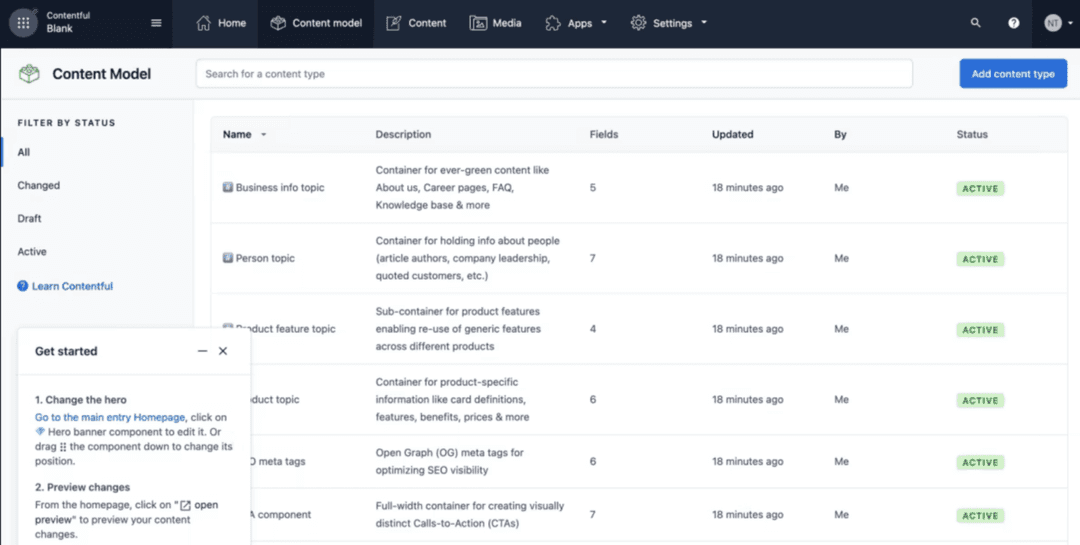 Contentful interface
Contentful Core Capabilities
Contentful CMS goes beyond traditional CMS features, providing a dynamic content infrastructure designed for the future of digital content.
*Rich Text Editor
Contentful’s rich text editor supports embedded media, inline entries, hyperlinks, and custom content blocks — giving editors a powerful writing environment without requiring HTML knowledge.
*Localization and Internationalization
Contentful supports multi-locale content out of the box. You can manage translations for dozens of languages from a single space, with field-level locale control and fallback logic for partially translated content. This makes it a go-to choice for global brands managing regional variants at scale.
*Granular Roles and Permissions
Team-based workflows are well supported. Contentful allows fine-grained role configuration, controlling who can create, edit, publish, or delete content at the space, environment, or content-type level.
*Asset Management and CDN Delivery
All media assets uploaded to Contentful are served via a global CDN with built-in image transformation: resizing, format conversion (WebP, AVIF), and quality optimization happen at the URL level, reducing the need for a separate image processing pipeline.
Whether you’re building immersive web experiences, managing sprawling product catalogs, or delivering personalized content at scale, Contentful provides the tools and flexibility needed to succeed.
Ideal project for Contentful
Contentful’s headless, API-first architecture makes it perfect for medium-to-high complexity projects needing fast launches like dynamic event platforms with real-time agendas, multilingual marketing microsites, or Next.js-powered SaaS landing pages that scale seamlessly.
Teams love its intuitive content modeling, global CDN delivery, and asset management for quick iterations and future-proof growth from startup campaigns to enterprise experiences.
However, for teams that outgrow Contentful’s pricing model or require deeper backend control, migration to a custom CMS or alternative headless CMS may be the next step. Explore how to migrate from Contentful.
What is the difference between Contentful’s free plan and paid plans?
Contentful pricing offers three tiers: Free, Lite, and Premium.
-
The Free plan is $0 forever and includes up to 10 users, 100K API calls/month, and 50 GB/month CDN bandwidth, plus 1 Starter Space. PulseSignal It’s suited for learning the platform, personal projects, or proof-of-concept work.
-
The Lite plan is $300/month and bumps limits to 20 users, 1M API calls/month, and 100 GB/month CDN. PulseSignal It includes all Free tier features plus additional solutions, and is best for smaller businesses or teams managing a single project. Wise Paid overages are allowed at $5 per 1M extra API calls.
-
The Premium plan offers the most flexibility, scaling to hundreds of users, and includes a dedicated Customer Success Manager, guaranteed SLA response times, 24/7 global support, and access to Professional Services. Contentful Pricing is custom and negotiated with sales.
The biggest practical differences beyond usage limits are support and collaboration features, the Basic/Lite plan adds enhanced editor tools like field comments, a presence indicator, and the Launch app for coordinating multi-content releases.
If you have have outgrown your legacy content system or need to migrate, for instance, from Wordpress to Contentful, get in touch with our engineering team.
Working with Contentful CMS Development Company
Contentful’s flexibility is one of its greatest strengths, and one of the reasons working with an experienced Contentful CMS development company makes a meaningful difference. Content modeling decisions made early in a project have long-term consequences for editor experience, API performance, and scalability. Getting them right requires both technical depth and editorial empathy.
At FocusReactive, we’ve implemented Contentful across industries ranging from global automotive brands to high-growth SaaS platforms. Our work includes:
- Caleffi: a global product catalog built on Contentful, with structured content modeling supporting dozens of product families across multiple languages
Our Contentful engagements typically include:
- Production-ready Contentful + Next.js setups delivered in 2–4 weeks
- Content model architecture designed for long-term editor usability and API efficiency
- Migrations from Webflow or migrations from WordPress, preserving URL structure and SEO value
- Scalable multi-tenant architectures for enterprise and agency use cases
- AI-driven semantic search and personalization experiences
Book your free 30-min Contentful audit, and scale like EasyPark (2.5M users/month).



 Eugene Boruhov