Headless CMS for startups: how to scale without enterprise pricing surprises
In this article, we compare the two most common approaches to building headless CMSs for startups: managed SaaS platforms (with enterprise plans) and self-hosted architectures with controlled costs. The goal is to help you choose a stack that scales with your business, provides content flexibility, and avoids pricing surprises. I'll also show that migration done by professionals isn't so scary if you're already overpaying.

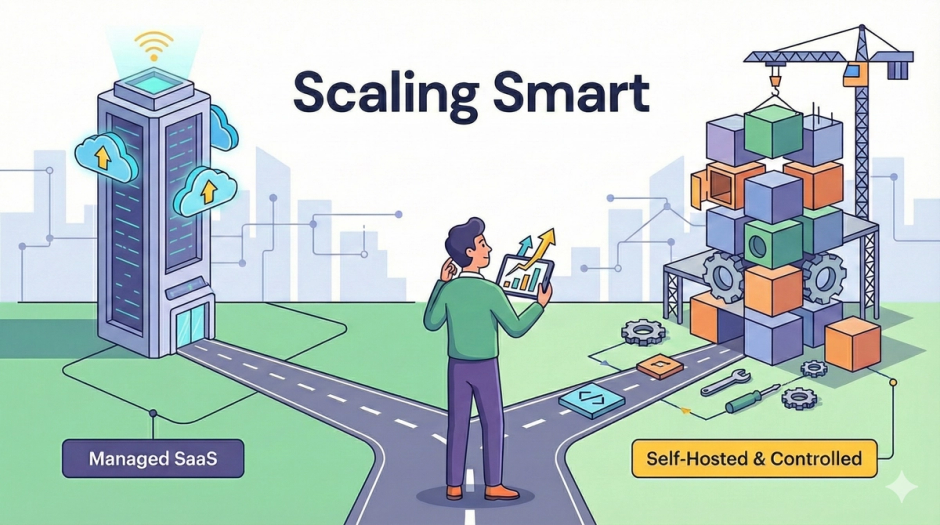
Every startup strives for growth.
Growth means more users, more content, more traffic, more markets—and, inevitably, higher costs. The goal isn't to avoid these costs, but to ensure they grow predictably and sustainably, rather than being a surprise after the business achieves success.
This article is written for startup founders and product team leaders who are either:
- choosing a headless CMS with growth in mind, or
- already scaling and beginning to question whether their current configuration will be relevant in a year or two.
The purpose is not to promote or discourage any specific platform. Instead, we'll explore two common architectural approaches and how they impact startups as they grow - financially, operationally, and strategically.
Why Headless CMS Has Become the Default Choice for Startups
In 2025–2026, a headless CMS is the standard approach for modern startups.
From a business perspective, it allows for:
- accelerating time to market,
- independently updating content without redeploying the entire product,
- reusing content across websites, mobile devices, and future channels,
- ensuring high performance and SEO optimization using modern frameworks like Next.js.
However, while most startups choose headless CMS solutions, far fewer consider how different headless approaches scale as their businesses grow.
The reality of a startup: growth always increases complexity and costs.
As startups grow, several things typically happen simultaneously:
- more content is created,
- more people need access to the CMS,
- traffic increases,
- preview and testing environments are implemented,
- localization and SEO expand the reach of content.
This is all normal. The key question is how your CMS and hosting costs respond to this growth.
Two Common Approaches to Building Headless CMSs for Growing Startups
From a business perspective, most startups ultimately choose between two main approaches.
Approach 1: Managed SaaS Headless CMS with Enterprise Plans
Platforms such as Storyblok and Sanity, combined with managed hosting solutions like Vercel, offer a powerfull proposition.
They provide:
- fast onboarding,
- polished editorial experience,
- minimal infrastructure responsibility,
- enterprise-grade support, SLAs, and security features.
For many startups - especially early on - this is the right and pragmatic choice.
At the same time, it’s important to understand how costs typically scale in this model. Pricing is often influenced by:
- number of editors and roles,
- API usage and content volume,
- number of environments (preview, staging, production),
- traffic and bandwidth,
- advanced workflows, localization, or compliance requirements.
As startups grow, these factors usually grow together.
Vercel Pricing Page
 Pricing
Storyblok Pricing Page
 Storyblok pricing
Sanity Pricing Page
 Sanity pricing
Why this matters:
Enterprise plans are not a problem by themselves. They become a problem only when teams reach them by surprise, without planning for how costs will scale alongside the business.
Approach 2: Self-Hosted or Controlled Headless CMS Architectures
Another valid approach is using a self-hosted or controlled CMS architecture, such as Payload and similar solutions.
From a business perspective, this model changes how scaling works:
- fewer platform-imposed limits,
- costs driven primarily by infrastructure and engineering,
- full ownership of content and data,
- reduced dependency on pricing tiers.
Instead of paying more as usage grows inside a SaaS platform, startups mainly invest in:
- hosting and infrastructure,
- engineering and operational expertise.
 Payload
This approach often leads to more predictable long-term costs for fast-growing startups, but it requires a stronger technical foundation and experienced teams.
Flexibility Becomes Critical as the Market Changes
One aspect that startups often underestimate is the frequency of changes in content operations.
Markets evolve quickly. Startups may suddenly need to:
- introduce new content types,
- adjust editorial workflows,
- add custom validation or publishing logic,
- expand translation and localization strategies,
- integrate content more deeply with product features.
With large managed CMS platforms, these needs are often addressed through:
- existing platform features,
- predefined workflows,
- vendor roadmaps,
- or workarounds that don’t always fit perfectly.
While enterprise CMS platforms are powerful, they are designed to serve many different customers at once. As a result, their solutions may not always align with a startup’s specific and time-sensitive needs.
Controlled, self-hosted CMS architectures allow teams to:
- implement custom content features immediately,
- adapt workflows without waiting for platform updates,
- align content operations directly with business logic.
This flexibility can become a competitive advantage when startups need to react quickly to market changes.
The Real Question Isn’t “Which CMS Is Better?”
The real question is:
How do we want our costs, flexibility, and operational complexity to grow as our startup grows?
- Managed enterprise platforms optimize for convenience and support.
- Controlled architectures optimize for long-term predictability and adaptability.
Problems typically arise when startups choose one model early on, and only later realize that their business has outgrown the assumptions underlying that choice.
What If You’ve Already Started and Costs Are Rising?
Many startups reach a stage where they think:
“We launched fast, but now our CMS and hosting costs are growing faster than expected.”
This is common and expected.
It doesn’t mean the initial decision was wrong — it usually means the startup has entered a new growth phase.
At this stage, migration may seem daunting:
- fear of downtime,
- fear of SEO impact,
- fear of disrupting ongoing business.
In reality, modern headless architectures allow migrations to be:
- incremental,
- low-risk,
- SEO-safe,
- aligned with business priorities.
With experienced professionals, migration becomes a controlled transition, not a risky rewrite.
Final Takeaway
Every startup wants to grow - and growth will always increase costs.
The goal is not to avoid enterprise platforms or premium tooling.
The goal is to choose an architectural approach that stays sustainable as the business scales.
Whether you're starting your migration today or already considering it, the right strategy and the right partners can ensure growth feels like progress, not like opening increasingly daunting bills every month.
Scaling your startup should be exciting.
Your infrastructure should support that — not make it stressful.
Headless CMS for Startups: Scaling Without Pricing Surprises – FAQ
Answers to common follow-up questions about scaling a headless CMS for startups, focusing on cost, architecture choices, and team impact.
Common implementation and scaling questions founders and product teams ask when choosing or rethinking a headless CMS architecture.
More posts in this category
Choosing a Headless CMS in 2026: A Straight-Talk Guide
The headless CMS market is crowded with platforms making similar promises. Strip away the marketing and you'll find they serve fundamentally different needs. This opinionated guide tells you what each platform actually does well, where it falls short, and who should use it. No politics, no hedging.
Compare Open Source CMS in 2026
The two best open-source headless CMS options are Directus and Payload. Both offer excellent flexibility, full data ownership, and strong AI capabilities.
Strapi and Directus for marketing websites
Scaling beyond the SaaS ceiling? Choose Strapi or Directus for marketing websites. Discover the best choice for editorial speed, data managing, and AI logic in 2026