


The article about Vercel hosting is written primarily for frontend developers and technical decision-makers, those who:
- Are evaluating hosting platforms for a new project or considering migrating an existing one
- Already know what Next.js, SvelteKit, serverless functions, and JAMstack are (none of these are explained)
- Have enough authority to choose infrastructure (solo devs, tech leads, CTOs at small-to-mid companies)
- Are comparing Vercel against alternatives like AWS, Netlify, or Cloudflare
TL;DR
Vercel hosting is the strongest choice for modern frontend frameworks now, and it remains the gold standard for Next.js, offering instant deployments, global edge delivery, and a growing AI toolchain. It’s less suited to projects that need complex backend logic, persistent connections, or low-level infrastructure control.
While Vercel is ideal for rapid frontend deployment and AI orchestration, AWS for instance remains the best choice for organizations seeking maximum infrastructure flexibility, dedicated backend clusters, and highly scalable persistent databases.
Whether new development or complex migrations, AWS provides the low-level control and scalability that serverless platforms often abstract away.
Vercel Hosting Explained
Vercel has rapidly grown in popularity among developers, becoming one of the leading platforms for modern web hosting. While originally associated with Next.js, Vercel is now a full-featured hosting solution that supports a wide range of frameworks and use cases.
Its mission is simple: to make deploying, scaling, and collaborating on web applications effortless. In this article, we explore the latest features, benefits, and limitations of Vercel to help you decide if it’s the best solution for your next project.
Who host on Vercel
Vercel’s customer base spans a wide range of team types and project sizes, which says a lot about where it fits best. As of early 2026, Vercel hosts over 2.3 million websites — the majority being marketing sites, documentation platforms, SaaS frontends, and AI-powered web apps. Enterprise customers include The Washington Post, Auth0, Uber, HashiCorp, and MotorTrend, typically using Vercel for public-facing frontend properties where deployment speed and global performance matter more than backend flexibility.
On the AI-native side, companies like OpenAI, PayPal, Ramp, and Supreme build on Vercel — drawn by the tight integration between the AI SDK and the deployment platform. AI-native startups without dedicated DevOps teams are a particularly strong fit: companies like Leonardo.
AI and Relevance AI run production workloads at scale on Vercel precisely, because the platform removes the need for infrastructure specialists. The pattern that emerges is consistent — Vercel tends to win where the primary deliverable is a fast, polished web interface, the team is frontend-heavy, and the ability to ship and iterate quickly outweighs the need for deep infrastructure control.
Vercel Hosting Pros
- Although Vercel was created for Next.js applications, it supports Nuxt, SvelteKit, Astro, Remix, Vue, Vite, and more. This makes it a versatile platform for static sites, SPAs, and modern web frameworks beyond its original ecosystem. Whether you’re building a dynamic single-page application or a static site, Vercel provides an adaptive hosting environment to suit your needs.
 The native Next.js platform
- Rapid Deployment & Git Integration. Deployments are tightly integrated with GitHub, GitLab, and Bitbucket, allowing every branch to spin up a live preview automatically. This “preview deployment” workflow is one of Vercel’s most developer-friendly features, giving teams instant feedback before merging code.
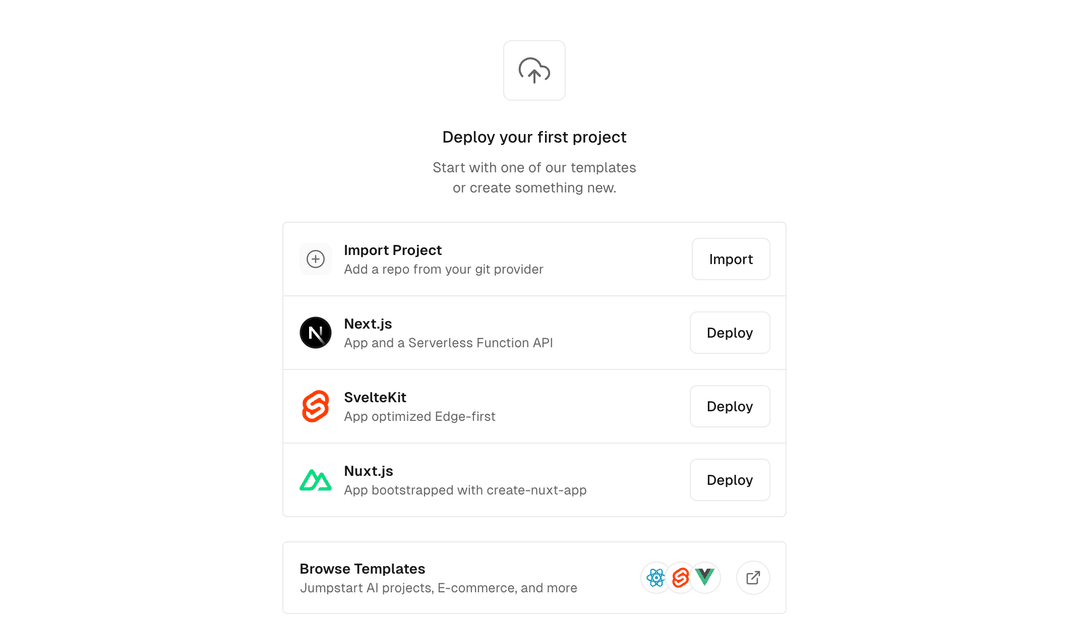 Rapid Deployment
- Collaboration & Integrations. Vercel integrates with popular tools like databases, CMS platforms, and communication apps such as Slack. Its combination of a user-friendly dashboard and a powerful API makes it easy to manage projects at scale, whether for individuals or teams.
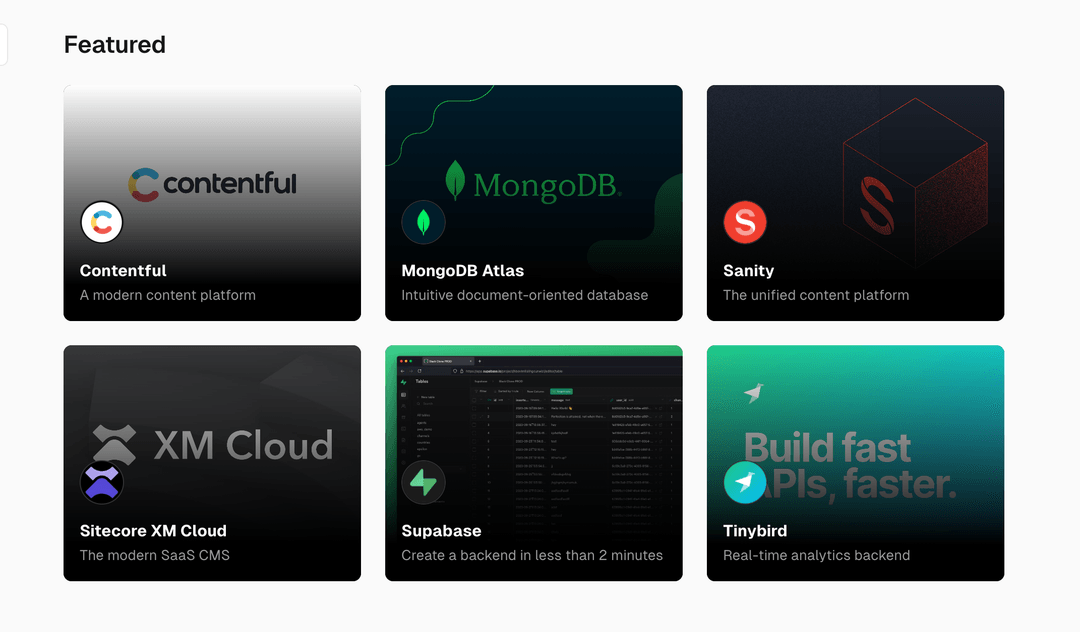 Integration and Collaboration
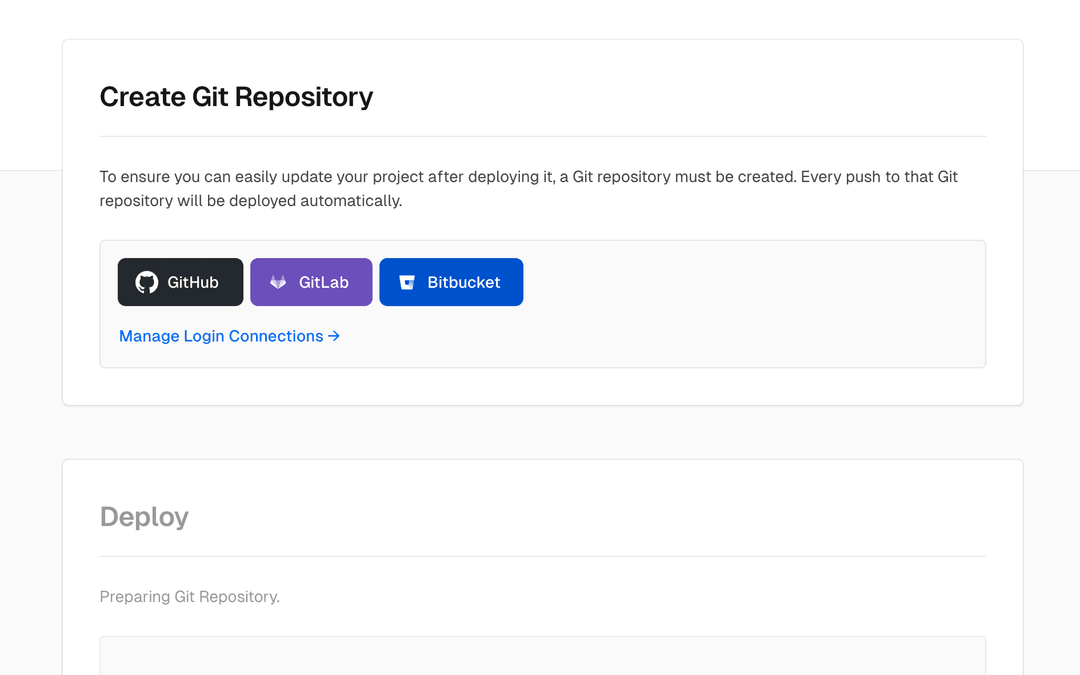 Version control systems
-
Global CDN, Automatic HTTPS & Advanced Edge Network. Vercel’s global content delivery network (CDN) and automatic HTTPS configuration ensure that your content is delivered quickly and securely, no matter where your users are located. Recent updates have also improved the platform’s edge network capabilities, reducing latency and improving overall performance.
-
Free Tier & Flexible Pricing. The free tier is generous enough for personal projects and small applications. Paid tiers scale with usage, offering enterprise-ready features such as SSO, advanced observability, and SLAs. Pricing is flexible, but costs can rise with heavy usage of serverless functions or build minutes.
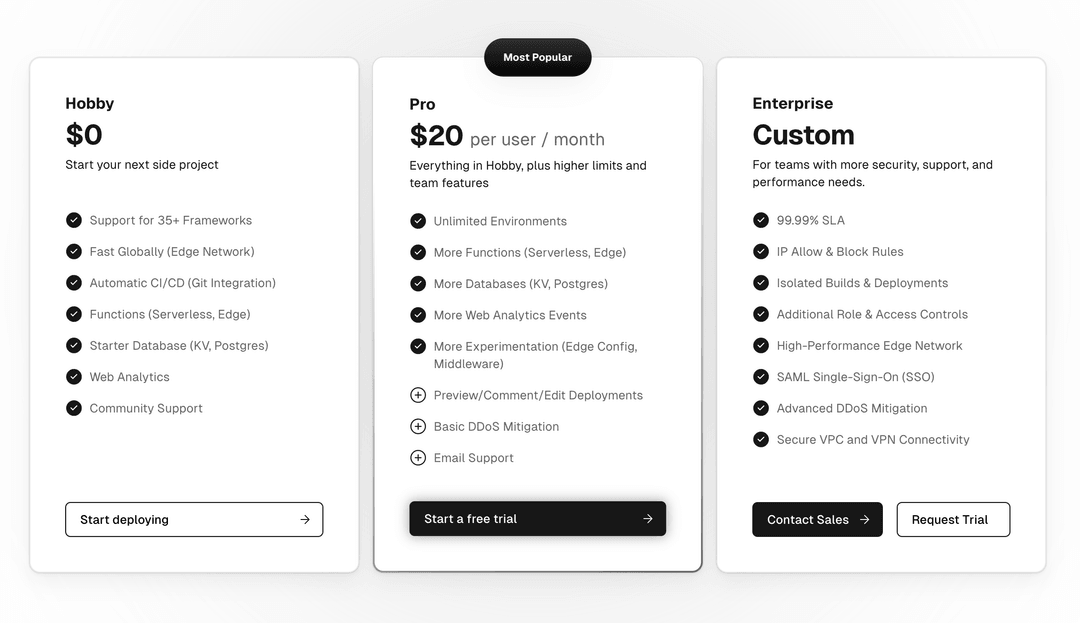 Vercel pricing
 -
Developer-Friendly Experience. It emphasizes simplicity: instant live previews and rollbacks, streamlined build processes, built-in CI/CD pipelines, environment variable management, support for cron jobs and serverless functions and automated scaling. All of this enables developers to focus on writing code rather than maintaining infrastructure.
-
User-friendly interface and robust API The platform’s interface is intuitive, making it easy to manage multiple projects at once. And if you like automation, a powerful API lets you handle almost everything programmatically - mirroring what you can do in the UI, but with added flexibility to customize your workflow. Latest features of Next.js
-
Performance & Scalability. High-speed server responses, efficient resource usage, and advanced caching techniques mean Vercel can handle traffic spikes with ease. Its evolving edge network and performance optimizations ensure your applications stay responsive as they grow.
-
Monitoring & Observability. Vercel provides several built-in tools to monitor performance, track errors, and analyze builds:
- Real-time logs and metrics: View serverless function executions, error rates, and latency.
- Build analytics: Track build times, deployment frequency, and preview environments.
- Integrations: Connect with third-party tools like Sentry, Datadog, or Logflare for advanced monitoring.
These capabilities help teams quickly identify and resolve issues, ensuring high reliability for production applications.
- Security Features. Vercel includes multiple layers of security by default, reducing operational burden:
- Automatic HTTPS with free SSL certificates.
- Edge-level security to protect against DDoS attacks and malicious traffic.
- Environment secrets: Safely store API keys, tokens, and credentials for serverless functions.
- Role-based access control (RBAC) for team collaboration and enterprise plans.
These features allow developers to deploy quickly without sacrificing security.
- Infrastructure Built for AI. Vercel has evolved into a comprehensive AI cloud. With the Vercel AI SDK and AI Gateway, it has become the industry standard for building and scaling generative AI applications and agent-based workflows.
Vercel’s built-in support for response streaming, prompt management, and global model orchestration makes LLM integration a first-class part of the web development workflow.
Vercel Hosting Cons
-
Limited Backend Support. While Vercel is great for front-end and serverless functions, it may not be the best choice if your project requires heavy backend processing or support for specific server-side languages. For complex server-side logic, you may need to supplement Vercel with additional backend services.
-
Cost at Scale. The free plan is great for small projects, but costs can quickly add up as you scale. If your app requires advanced features or heavy usage, be prepared to invest — enterprise plans can be especially relevant. It’s important to weigh these costs against your project’s requirements.
-
Lack of Low-Level Control. Vercel abstracts away the server, which means you cannot customize network configurations, install system libraries, or run unconventional tech stacks. For some teams, this abstraction is a limitation rather than an advantage.
When to Choose Vercel?
Vercel is ideal for:
- Next.js applications and other modern front-end frameworks like Nuxt, SvelteKit, and Astro.
- Projects where you prefer to avoid managing server infrastructure.
- Static sites, single-page applications (SPAs), full-stack projects with serverless functions, and JAMstack architectures.
- Teams who value rapid deployment and seamless tool integration.
- Frontend applications where backend needs are minimal or can be met with simple serverless functions.
When to consider alternative hostings:
- Your project has complex backend requirements that need dedicated server environments.
- You require detailed control over server configurations or custom networking.
- Scaling costs could become prohibitive given your expected traffic or usage.
Quick Decision Guide
-
Choose Vercel if
- You’re building with a modern front-end framework (Next.js, Nuxt, SvelteKit, Astro, Remix, Vue, Vite).
- You value speed of deployment and preview environments for every branch.
- Your backend needs are lightweight and can be handled by serverless functions or third-party APIs.
- You want global performance out of the box without managing infrastructure.
-
Look elsewhere if
-
You require advanced DevOps customization, complex networking, or are planning a strategic migration to a more robust, independent cloud infrastructure like AWS to avoid vendor lock-in and optimize long-term costs.
-
Your web application requires complex backend processing, persistent WebSocket connections, or long-lived tasks.
-
You need detailed server customization or low-level network control.
-
You’re operating at massive scale with strict budget constraints.
Vercel pricing details
For a detailed breakdown of how costs compound at scale, including real bill examples and optimization strategies, see our Vercel cost optimization guide.
Vercel Alternatives: Worth Considering in 2026
If Vercel hosting doesn’t fully fit your needs, here are some suitable alternatives:
-
AWS: The most flexible option for teams that need full infrastructure control: dedicated servers, custom networking, managed databases, and fine-grained security and compliance configuration. Higher operational overhead, but no ceiling on what you can build or customise.
-
Cloudflare Pages and Workers: The strongest competitor for edge-first applications. Cloudflare’s global network is larger than Vercel’s, and its D1 database and AI model execution run at the edge. Better suited to latency-critical applications that need data processed close to the user.
-
Netlify: A mature alternative with a similar developer experience. Its “Compose” features support more complex orchestration, and it’s a solid choice for teams that want a managed, frontend-centric workflow with integrated security and a long track record.
-
Fly.io / Render: These bridge the gap between simple hosting and full cloud setups. Both support Dockerised applications, persistent WebSockets, and long-running background processes, capabilities that Vercel’s serverless model doesn’t cover. Better options if your stack doesn’t fit the serverless mould.
-
AWS Amplify: A Vercel-like experience for teams already in the AWS ecosystem. Frontend-friendly, with a clear path to deeper AWS integration as a project grows.
Is Vercel Right for You?
Vercel hosting is one of the best platforms for deploying modern frontend applications quickly and reliably. Its developer experience is genuinely excellent, and its expanding AI tooling makes it a compelling choice for teams building LLM-powered products.
The tradeoffs, serverless constraints, limited backend support, and cost at scale, are real, but well-understood. For many projects, they won’t matter. For those where they do, the alternatives above are worth a closer look.
For a personalized technical consultation, consider contacting official Vercel integration partners or contact us directly - Vercel’s Official Integration Partners for tailored advice and solutions that maximize your project’s potential.

 Sergey Labuts

 Maksim Hodasevich



.png&w=828&q=90)
