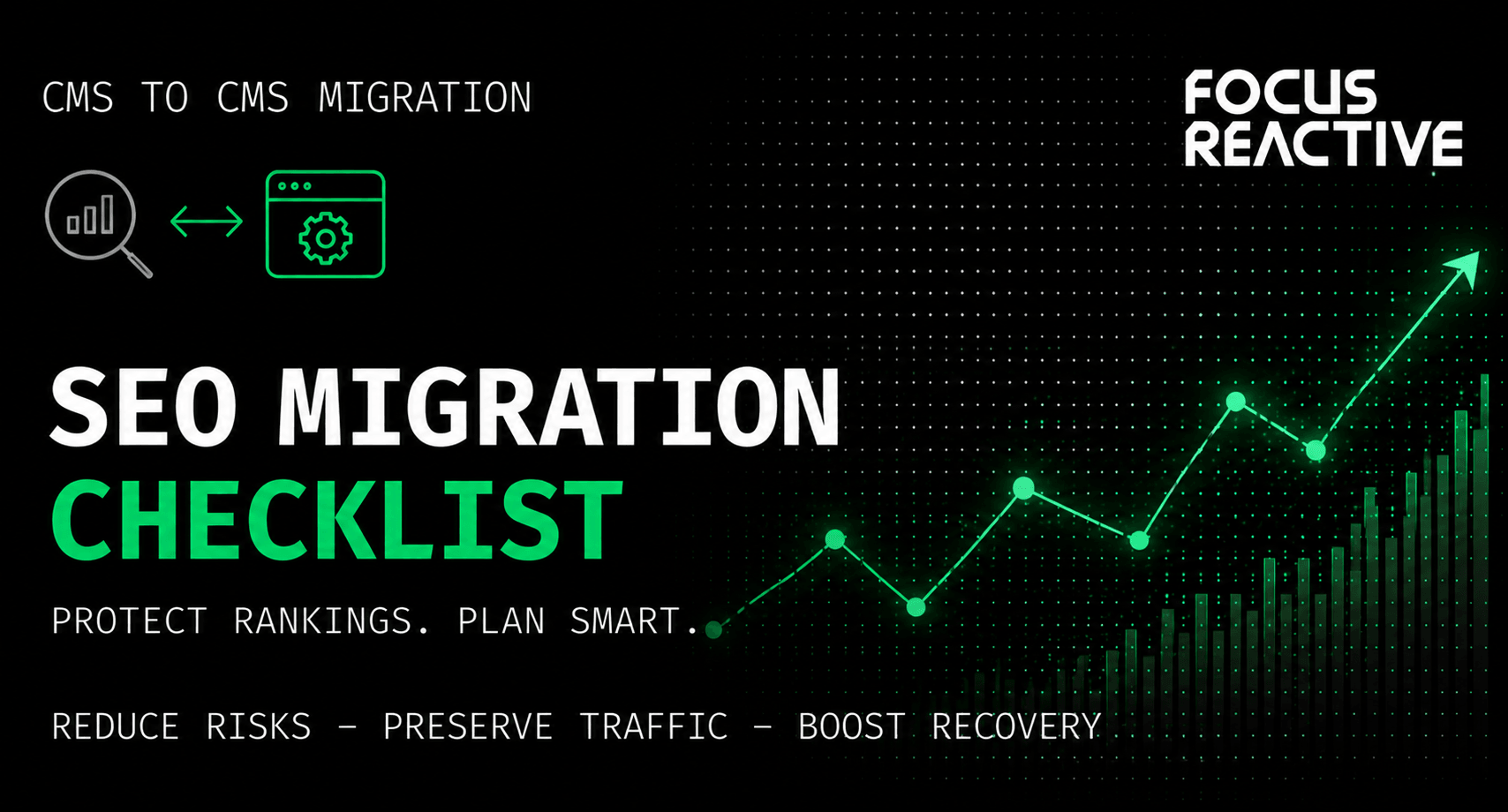





Technical SEO migration checklist for large sites
A practical checklist for replatforming SEO pages without breaking redirects, crawl paths, or indexation at scale.


One-off page creation quickly becomes an editorial and QA bottleneck. Scalable systems require templated generation, structured API inputs, and clear governance.
Loose content modeling and vague entity definitions lead to overlapping, thin pages that compete with each other instead of building topical authority.
Fragmented systems block growth. Programmatic SEO only works when product data, editorial input, and publishing share one unified, API-driven operating model.
Crawlability, canonicals, and cache invalidation can't be an afterthought. If not engineered into the platform from day one, the architecture breaks under real content volume.
We deliver technical programmatic SEO services that turn content operations into a high-performance, automated system. We design and build headless and composable SEO platforms utilizing Next.js, Edge caching, and market-leading Headless CMS architectures.
Structured content models, landing page generation, reusable components, strict validation rules, and technical SEO controls are built into the platform from the start. That gives your team the ability to scale taxonomy-driven pages—whether for a massive e-commerce catalog or an enterprise knowledge base—without sacrificing Core Web Vitals or indexation efficiency.
No template sprawl. No editorial bottlenecks. Just a robust infrastructure built to grow cleanly, engineered by a senior-heavy team with a "get things done" mentality.

We engineered a programmatic SEO engine for a rapidly expanding family entertainment brand using Payload CMS and Next.js. By bulk-importing CSV data and integrating Google Places APIs, the platform automatically generates a full set of localized subpages with perfectly structured JSON-LD data across three languages, completely removing the developer bottleneck.
Proof Point

We built a highly performant, programmatic SEO platform on Next.js and Storyblok to support a global eSIM provider. By dynamically linking country pages to real-time pricing APIs and utilizing AI-powered translations, we created a scalable architecture that captures high-intent organic traffic worldwide.
Proof Point

We engineered a Next.js platform that programmatically generates over 1,000 localized city and neighborhood pages. By integrating third-party data providers and a PostgreSQL database, the system automatically renders dynamic maps, custom reports, and highly targeted local SEO footprints at scale without manual editorial work.
Proof Point
FocusReactive successfully took over and enhanced our existing site and shop, making the platform faster, more stable, and significantly improving the user experience. The team delivered high-quality work on time, reduced development overhead, and proved to be proactive, knowledgeable, and highly reliable throughout the collaboration.
I found FocusReactive through ChatGPT and chose them because of their geographic proximity and the exact tech stack we needed.
The team took charge of the research, concepting, planning, and development of our entirely new platform. FocusReactive successfully delivered a fully functional headless website.
From a project management standpoint, FocusReactive has done an amazing job. Everything has been very well communicated via our virtual meetings, and the team has always met deadlines. What impressed me most is that FocusReactive has understood the needs of the project, been flexible, and has brought high-skilled developers. The main project is finished, but we will definitely continue development with them in the future.

"We needed a headless CMS solution to enter the highly regulated US sports betting and online casino market. We chose Focus Reactive to develop it using Sanity. Because of them, today we have a tailor made, flexible and high-quality CMS Studio on deadline. Impressed by the quality of work and transparency throughout the process."

FAQs About Programmatic SEO Platforms
A programmatic SEO platform combines structured data, a taxonomy and templates to publish an indexable page for each query where you have unique data.
We enforce strict schema design and validation guardrails inside the Headless CMS. While we utilize structured data APIs and LLM-assisted content enrichment, a critical human review process is built into our publishing workflow. This human-in-the-loop approach ensures that every page provides unique, intent-driven value to the user, actively preventing scaled content abuse, taxonomy overlap, and indexation cannibalization.
Teams with complex, high-stakes content needs: e-commerce and catalog businesses with extensive PIM databases, large organizations managing public knowledge bases, and content-heavy marketing sites looking to capture long-tail, hyper-localized search intent. We deploy local pages only where there is real local inventory, data, or service. No templated city swaps.
If your CMS relies on rigid visual templates rather than decoupled structured data, scaling becomes a bottleneck. We build code-driven content models. This allows developers to design the architecture once, empowering editors to dynamically generate new programmatic hubs based on clean, API-first taxonomy without breaking the frontend.
We engineer dynamic linking algorithms into the Next.js frontend and Node.js backend. This ensures logical parent-child relationships, siloed topical clusters, and optimized crawl paths, preventing orphaned pages even when dealing with massive, continuously updating data sets.
It works best with composable architecture. Decoupling the frontend allows us to utilize Incremental Static Regeneration (ISR) and edge-caching. ISR gives you a fast TTFB baseline for good Core Web Vitals.
We integrate technical SEO controls, Lighthouse CI/CD checks, and edge analytics hooks directly into the platform. Lighthouse CI catches regressions before deploy; real-user monitoring and Search Console track field vitals and indexing.
We perform safe, data-driven migrations from legacy monoliths. We audit the existing URLs, map them to a new structured Headless CMS schema, and set up automated redirect engines and API ingestion pipelines to protect existing organic traffic through the move and let the platform scale with your data.