
TL;DR
Payload, Strapi and Directus are all called open source, but only Payload is MIT licensed all the way, with no revenue threshold and no paid plans on top of the code. Strapi has a free MIT Community edition, and sells seats and features like SSO separately. Directus is fully free only for companies under $5M in revenue and 50 employees, and above that the free tier stops at 3 seats and SSO starts with the $499/month Team plan. Vanilla Payload is not perfect here either, because SSO and audit logs are part of Payload Enterprise. That’s why we built Ideal CMS: to bridge this gap and include the features our clients typically want.
What does a “free” CMS actually mean?
For me, a free CMS is a CMS that you fully own, and you don’t have to constantly pay a SaaS provider for it. But “free” has several levels, and before making a decision about which CMS to choose, you need to know about them:
- SaaS providers. You pay a monthly fee for usage, for seats, for teams. Not free at all.
- Convenient infrastructure, like Vercel and Neon or another managed database provider. You don’t pay for seats and you don’t pay a SaaS provider, only for hosting. It’s not free, but it’s up to 100 times cheaper than a SaaS vendor. Even a high-load site might cost around $100 per month.
- Your own servers. You can go further, deploy the CMS on your own infrastructure and pay only for the server. A VPS like Hetzner will cost $10 or $20 per month, depending on the configuration.
- Static. You can go even further and build everything statically. It’s basically a folder with a domain attached to it, and it might cost $3 per month.
The most convenient and the most optimal one, I would say, is Vercel + Neon. We build it once, it works, and yes, we pay a bit more, but we remove the need to support a server that has to be running all the time.
Your own servers are a normal option when you have a team. But you need to understand that to support this infrastructure you need professional people who will look after it and guarantee that it works, and that takes time again. If this is your case, we have a post about self-hosted Next.js when Vercel is not an option.
And static is a special case. There are specific cases when it’s the right fit, and recently we talked to a company that wanted exactly this, a fully static website. But if we’re talking about a content marketing platform that is constantly updated, it most likely doesn’t fit, because part of the features simply can’t be implemented on static.
At FocusReactive we work with all 3 of them, so what you will read below is the same comparison we make in real proposals. For example, one client had just moved from WordPress to Strapi and didn’t want to move again, and another one, on Contentful, was choosing between Payload and Strapi. If you need more details about each of them, we have a Strapi overview and a Directus overview.
What licenses do Payload, Strapi and Directus use?
Let’s start with the licenses, because this is where “open source” means 3 different things.
Payload is MIT. There is no revenue threshold, no registration and no license key. You can use it commercially, change it and build your own products on top of it.
Strapi has an open-source core. The Community edition is MIT, it’s free for commercial use, you host it yourself, and the number of users is unlimited. Strapi is one of the most popular open-source CMSs, and it deserves it: it manages the content hierarchy for you, and its Dynamic Zones let editors build landing pages without a developer. But it’s not a fully open-source solution, because some features, like SSO, start to cost money. I will show the numbers in the next section.
What is the Directus license?
With Directus it’s a little different. Directus uses the MSCL license, which is source-available and not open source (source). If your organization makes less than $5M a year and has fewer than 50 employees, you can use the full platform for free, you only need to register and get a key. If you are above that, the free Core tier gives you 3 seats, 25 collections and 5 Flows, and no SSO (pricing). SSO starts with the Team plan, which is $499 per month billed yearly, with 10 seats included and $50 for every extra seat. Every version becomes GPLv3 after 4 years.
Again, Directus is a good product, and it’s not for nothing that it’s getting so popular. What is really good about it is that it can work on top of an existing SQL database. So if a client already has a database with their data, Directus can simply work on top of it (1), which is a big plus, because it doesn’t require any extra database work.
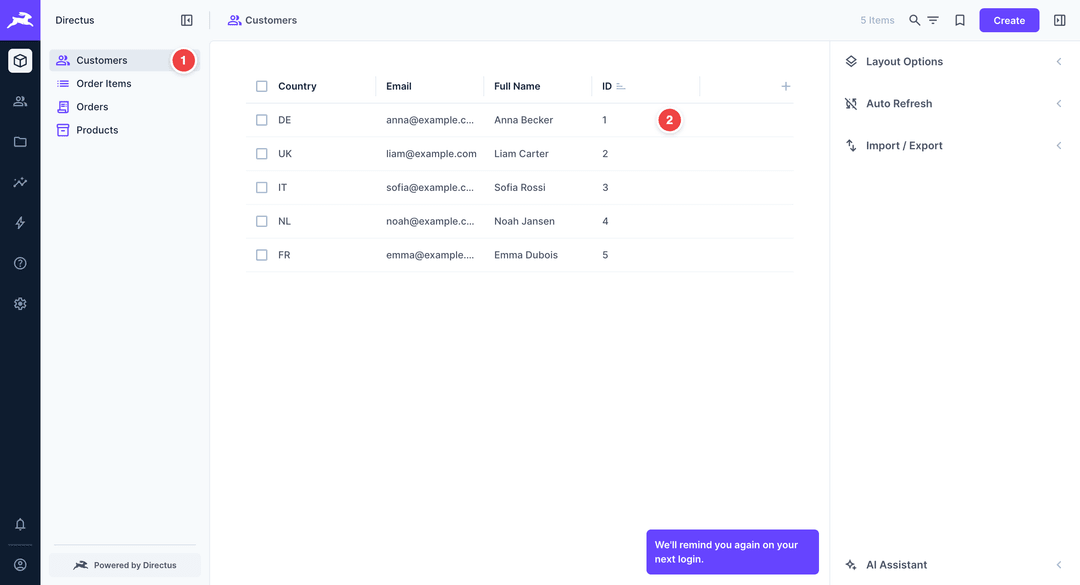 Directus Data Studio showing customers, orders and products tables from an existing Postgres database as collections
Directus on top of a database that was created without it: the existing tables show up as collections (1), with the data that was already there (2)
But my opinion is this: if you want real open source, without any limitations in the future, Directus is not the best option, because when your business grows you will start paying Directus anyway. If you are fine with that, it’s a totally logical choice.
How much does Strapi cost when you need SSO and audit logs?
Strapi Growth costs $45 per month with 3 users included, and every extra user is $15. The SSO add-on is $150 per month plus $50 per user (pricing). Audit logs and review workflows are available only on Enterprise. Growth also gives you Releases, 14 days of content history and 1,000 AI credits per month.
Let’s count it for a team of 10 editors that needs SSO. Growth is $45 + 7 × $15 = $150 per month, and SSO is $150 + 10 × $50 = $650 per month. Together it’s $800 per month, or $9,600 per year, and that’s before hosting and still without audit logs and review workflows. For the Contentful client I mentioned, our estimate put Strapi Cloud at roughly 2 to 5 times the cost of Payload hosting for the same needs.
The interesting part is that in the admin the feature is right there (1), you just need to upgrade (2).
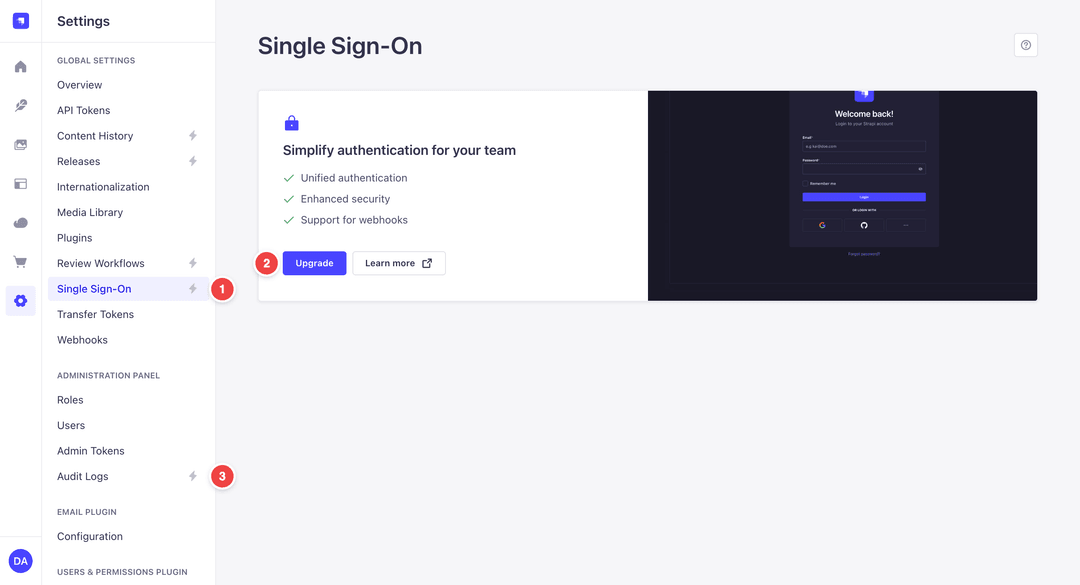 Strapi Community admin settings: the Single Sign-On page shows an Upgrade button, and Audit Logs and Review Workflows carry the same paid mark
In Strapi Community, SSO is visible in the admin (1) but sits behind an upgrade (2), and Audit Logs carry the same mark (3)
How do I feel about Strapi selling SSO and seats separately? Negatively, of course. Well, how negatively: it’s typical to sell features, and they need to make money somehow. I understand that for them it’s their bread. But it’s not necessary to make everything paid. They already have a cloud, so they could simply charge for the cloud, be a platform, and keep the product open source.
This is what Payload had. Payload was and still is fully open source, and they had Payload Cloud. After the acquisition by Figma they paused new projects there, and now they say they are building something better to replace it (source). I’m not a business-model expert, but it’s interesting why Strapi didn’t go the same way.
Is everything free in Payload?
No, and it would not be fair to skip this. Payload itself is MIT, but SSO, audit logs, publishing workflows and Enterprise AI are part of Payload Enterprise (source). So “Payload is free” is true for the core, and only partly true for what a big team needs.
What you get for free is already a lot: unlimited users, roles and access control, drafts, versions with restore, and localization. Versions, for example, work as a basic audit trail today. Every document has a Versions tab (1) where you can see what was changed and when (2), compare any 2 versions and restore the old one (3).
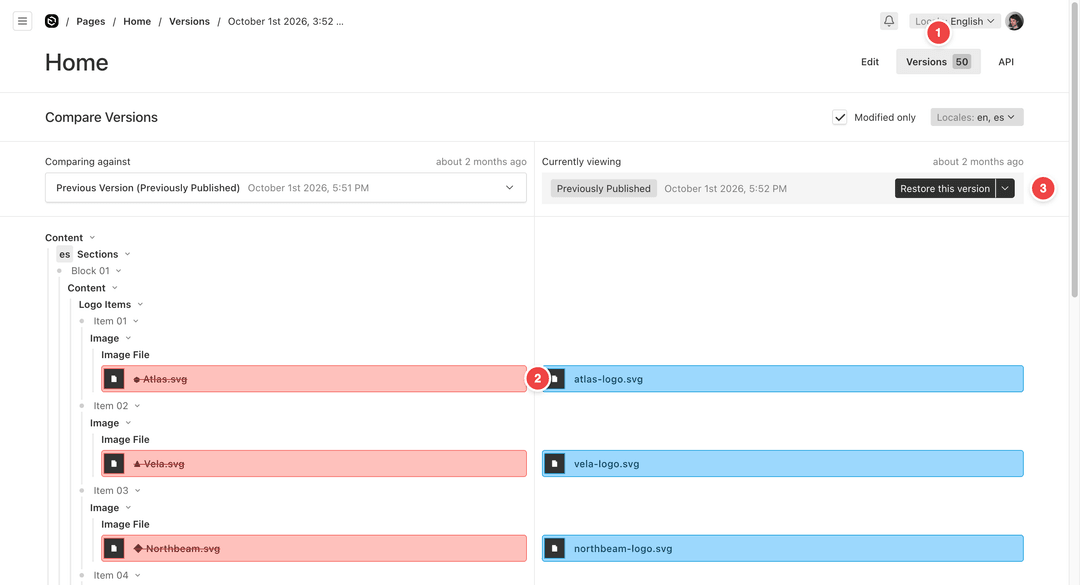 Payload version history: the Versions tab, a diff between 2 versions and the Restore button
Version history on every page: open Versions (1), see what exactly changed (2), and restore it in one click (3)
The difference from Strapi and Directus is what happens next. Payload gives you full access to the code and there are literally no limits on how you can extend it, so the missing features can be built on top. This is exactly what we did in Ideal CMS.
How does Ideal CMS cover the paid features?
In Ideal CMS, SSO is free, audit logs come as an open-source plugin, and approval workflows we build for the project. None of them is an Enterprise feature.
Let’s start with SSO. Why does a client need it at all? To control access. It’s very important for security, so attackers have fewer options to get into the system. And in corporate environments, companies use their own login providers, and we can’t just tell them “for the CMS you will use a login and a password”. No, it doesn’t work for them, for them it’s a dealbreaker. In some cases this decided the choice of CMS in favor of Payload, and I wrote more about it in Payload vs Sanity, Storyblok, Contentful.
In Ideal CMS, SSO works with any OIDC provider, like Auth0, Okta or Keycloak. You set 3 environment variables, and the login screen gets an SSO button (1) next to the regular form (2). It’s not an add-on, it’s just code you can read.
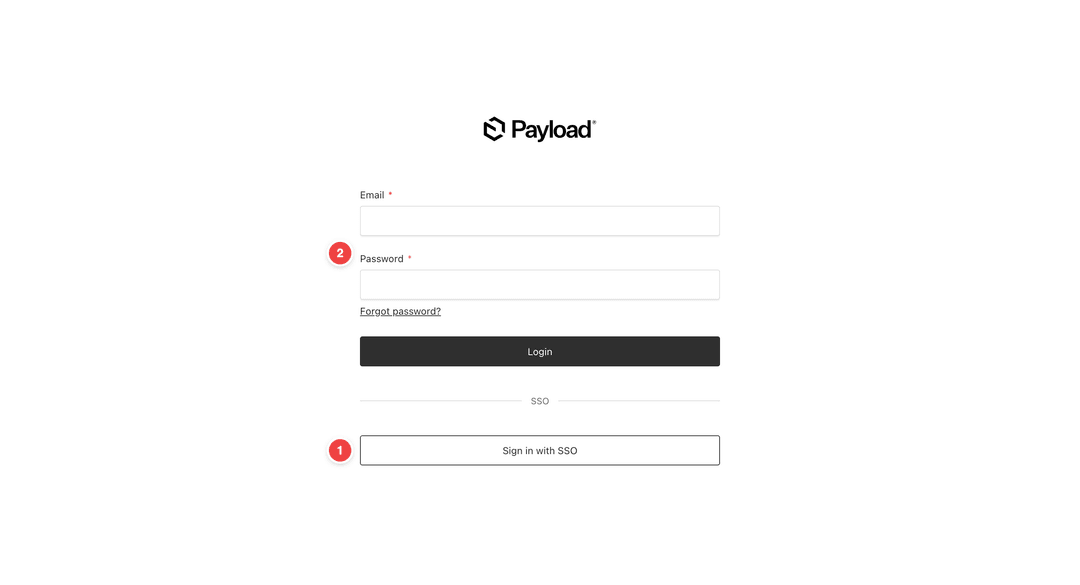 Ideal CMS login page with the regular form and a Sign in with SSO button
SSO in Ideal CMS: one button on the login page (1) next to the regular form (2), no add-on fee
Do clients ask about audit logs and approval workflows? Definitely, about both.
For approval workflows we don’t have a public plugin. For one client we built a Draft → Review → Publish workflow as a plugin, and since it’s a pretty simple and straightforward feature, we do it per project, when it’s needed. We’re also working on this plugin to make it useful both for people and for AI agents.
About audit logs, clients started asking only recently, and that’s actually why we built the plugin.
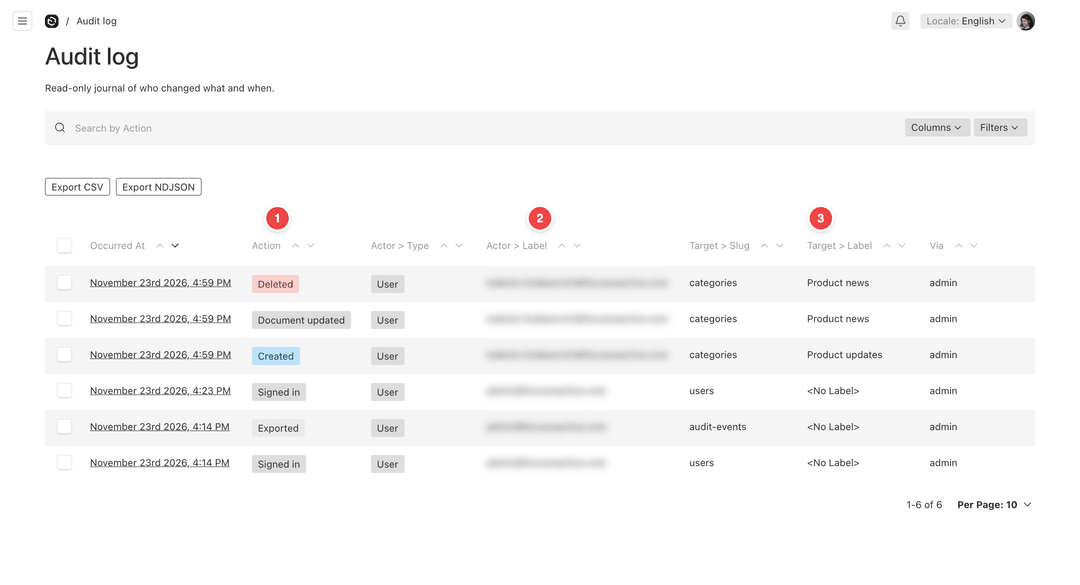 Audit log in the Ideal CMS admin: a read-only list of events with the action, the user, the collection and the document
Audit log in Ideal CMS: what happened (1), who did it (2) and to which document (3), in a read-only journal you can export
What I tell clients is that both are real, both are not an Enterprise feature, both will be your own solution, and you don’t have to pay extra for them every month.
To be honest, not everything we build is free. The Content Releases plugin is licensed, and the story behind it is in Payload++. Everything else is MIT.
Where is the lock-in in open source?
Open source has a lock-in too, but it’s a different one. You are not locked into a vendor, you are locked into the technical decisions of the tool: which databases it supports and how it stores the data.
Let me give an example. Payload needs to store the data somewhere, like any other CMS, and it has a certain set of database adapters: Postgres, SQLite and MongoDB. If we want to use an Oracle database for some enterprise use case, we can’t do it. Directus wins here, because it supports Postgres, MySQL and MariaDB, SQLite, Oracle, MS SQL and CockroachDB (docs). Strapi supports Postgres, MySQL, MariaDB and SQLite, and its docs say it’s not meant to be connected to a pre-existing database (docs).
Besides this, we agree to the architecture of the open-source solution. If Payload stores the data in a certain way, stores versions and relations in a certain way, we can’t influence it and we can’t freely change it. The same is true for Strapi and Directus.
But when we talk about ownership of the data, ownership of the infrastructure, and the features that we can add, remove or change, there is no lock-in here. Everything is customizable. And this is the difference with a paid feature: if SSO lives in a paid plan, its price can change tomorrow, and with MIT code nobody can switch it off.
Which one fits your developers?
Payload is a Next.js-based CMS from the beginning. Next.js is a React metaframework, React is the most popular web framework, and Next.js is the most popular metaframework. So I can name 3 reasons why Payload is technically stronger for us:
- The biggest ecosystem. A very big community, a lot of plugins and ready solutions, and a big possibility to customize and use the features of Next.js.
- Easy hiring. It’s easy to find a developer for this stack, and you can find one for any budget.
- AI knows this code. Because it’s the most popular stack, AI is trained on a huge amount of exactly the code that is written in Payload. So supporting a Payload project with AI can be much simpler.
On top of that you can add your own views and components to the admin (1). With Strapi and Directus we saw more limits there.
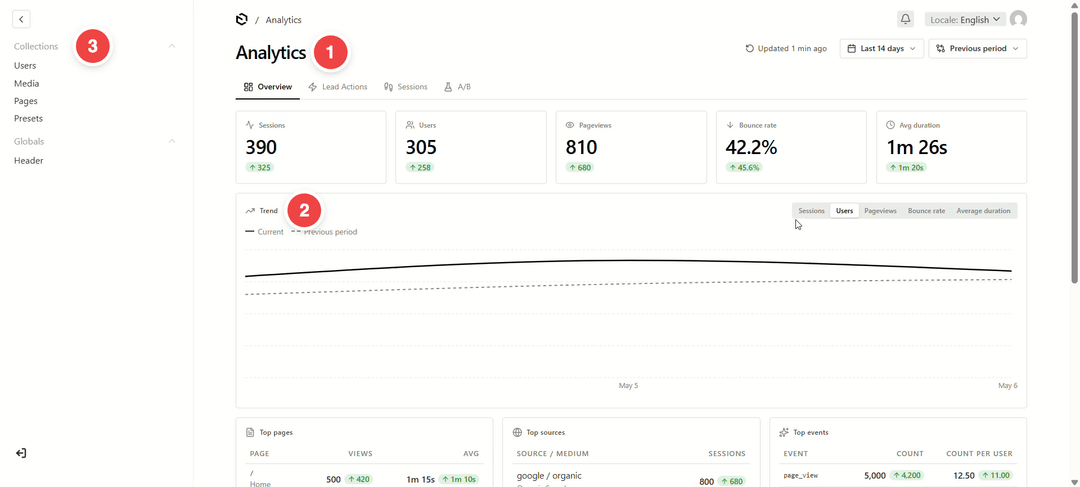 Analytics dashboard as a custom view inside the Payload admin, with sessions, users, pageviews and a trend chart, next to the standard collections in the navigation
A custom view (1, 2) living next to standard collections (3): the admin is yours to extend
The dashboard above is our Analytics plugin, and you can read more in our post about custom admin panels in Payload.
Where can Payload lose? Strapi and Directus can be used not only with JavaScript frameworks, but also with Ruby on Rails, PHP or C#. Directus is basically a layer on top of an existing database, so the UI framework can be any. If your company has several stacks, that’s a real plus.
Payload v4 is working on making Next.js optional. It’s in beta since October 2026, Next.js becomes one of the adapters, and there is already a TanStack Start adapter (@payloadcms/tanstack-start). So people will be able to keep React without the Next.js metaframework. We’re also working on splitting the admin and the frontend into separate apps in Ideal CMS, and in such a setup a frontend on any stack could fetch the content by API. But here I don’t want to speculate.
This is also why Ideal CMS is built on Payload and not on Strapi or Directus. First of all, because it’s fully open source. Second, because Payload is Next.js-based, the majority of our clients want Next.js, and along with other tools we are Next.js experts. We’re also an official Payload partner.
Should you choose Payload, Strapi or Directus?
To summarize: all 3 are free to start, but only Payload has no license conditions, and only Payload with Ideal CMS keeps SSO free when you grow.
| Payload (vanilla) | Ideal CMS | Strapi | Directus | |
|---|---|---|---|---|
| License | MIT | MIT (Content Releases licensed) | MIT core, paid Growth / Enterprise | MSCL, GPLv3 after 4 years |
| Free tier conditions | None | None | None for Community | Under $5M revenue and 50 employees, registration |
| Seats | Unlimited | Unlimited | Unlimited on Community; Growth $45 incl. 3, +$15/user | Above threshold: 3 on Core, 10 on Team, +$50/seat |
| SSO | Enterprise | Free, any OIDC provider | Add-on $150/mo + $50/user | Team $499/mo and up |
| Audit logs | Enterprise | Open-source plugin | Enterprise | Activity log, 30 days on Core, 90 on Team |
| Review workflows | Enterprise | Built per project | Enterprise | Built with Flows (5 on Core, 20 on Team) |
| Releases | Not built in, scheduled publish only | Licensed plugin | Growth and up | Not built in |
| Content history | Versions, free | Versions, free | 14 days on Growth | Revisions, 30 days on Core, 90 on Team |
| AI | Enterprise AI | Own provider and keys | 1,000 credits/mo on Growth | AI Assistant on all tiers, own LLM on Enterprise |
| Managed cloud | Payload Cloud: new projects paused, a replacement is in the works | None, any Node host | Strapi Cloud | Directus Cloud |
Sources: Payload Enterprise, Strapi pricing, Directus pricing, Directus v12 license change, Ideal CMS comparison table.
Choose Payload, or Ideal CMS, when you want to exclude all the limits and have a fully open-source system: no seat limits, no revenue threshold, and SSO without an add-on.
Directus could be the right choice when you have to work on top of an existing SQL database, and you’re under the threshold or ready to pay for the Team plan later.
Strapi fits when you need one CMS for several frontend stacks and you can live with paying for SSO, audit logs and review workflows as you grow.
These 3 are the most popular open-source CMSs, the ones everybody has heard about, and that’s why we compared them specifically. For a wider view we have Compare Best Open Source Headless CMS in 2026, and if you choose only between the other 2, there is Strapi vs Directus for marketing websites.
If you’re on Strapi or Directus and the next plan doesn’t make sense for you anymore, we can help you move to Payload. Or just start with Ideal CMS, the code is on GitHub.