Headless CMS for Startups: Scale Fast, Dodge Enterprise Price Shocks

TL;DR
The real question isn’t which CMS is cheapest today, it’s whether your costs grow linearly or exponentially as your startup scales. When choosing a headless CMS for startups, plan 12–18 months ahead, not just for launch day.
Payload (self-hosted) has zero licensing costs. You pay for infrastructure ($150-250/mo) and upfront engineering time. Flattest cost curve long-term, highest initial investment.
Storyblok hits a sweet spot for startups at ~$450-550/mo (Growth Plus) with 15 seats and 10 locales. The 20-seat cap means fast-growing teams hit Enterprise pricing sooner than expected.
Sanity looks cheap at $15/seat/month, but isolated staging datasets ($999/mo) and quota add-ons ($299/mo) can push costs to \$1,500+/mo. Wide range depending on your workflow choices.
Contentful is the most expensive option for startups. Premium tier typically runs $2,000-3,500/mo on annual contracts.
Why Headless CMS Has Become the Default Choice for Startups
In 2025-2026, headless CMS has become a mainstream choice for many startups and growing digital teams.
You get:
- Faster time to market,
- Content updates without redeploying the product,
- Reuse across web, mobile, and future channels,
- Strong performance and SEO when paired with frameworks like Next.js.
But here's what most teams skip: thinking about how their headless approach scales as the business grows. You pick a CMS, ship the first version, and move on. Eighteen months later, the invoice looks different. We've seen this pattern before.
Headless CMS for Startups: The Market Is Already All-In on CMS
The web content management market is projected to reach 15.3 billion by 2028 at a 13.5% CAGR, with 69% of global B2C decision-makers increasing their CMS investment year over year (Forrester).
In their 2024–2026 strategic roadmap, Gartner projected that by 2026, at least 70% of organizations would be mandated to acquire composable DXP technology, API-first and headless, over monolithic suites (Gartner). That timeline is now.
Over 70% of all websites already run on a CMS (W3Techs), and headless CMS has become a mainstream strategic consideration alongside template-based platforms. The shift isn't coming. It already happened.
Growth means more users, more content, more traffic, more markets — and inevitably, higher costs. The goal isn’t to avoid those costs; it’s to ensure they grow predictably, not as a surprise after you’ve already succeeded. That's the part that's easy to get wrong.
Whether you're choosing a headless CMS with growth in mind or already scaling and questioning whether your current setup will hold up in a year, the architectural decision you make now compound over time.
How CMS Costs Scale as Your Startup Grows
Growth compounds your content infrastructure in ways most teams don't anticipate until they're already paying for it.
- More content gets created.
- More editors need CMS access.
- Traffic increases.
- Preview and staging environments multiply.
- Localization and international SEO expand your content footprint across regions and languages. None of this is surprising — it's what scaling looks like.
The question is whether your CMS and [hosting] costs(https://focusreactive.com/nextjs-hosting-options-overview/) grow in proportion to that value, or whether they start outpacing it.That decision compounds.
The platform you pick when you're publishing 200 pages behaves very differently when you're managing 20,000, and the pricing model that felt reasonable at the start can look very different when you're running multiple environments, paying per seat, and hitting API rate limits you didn't know existed.
Two Approaches to Headless CMS for Growing Startups
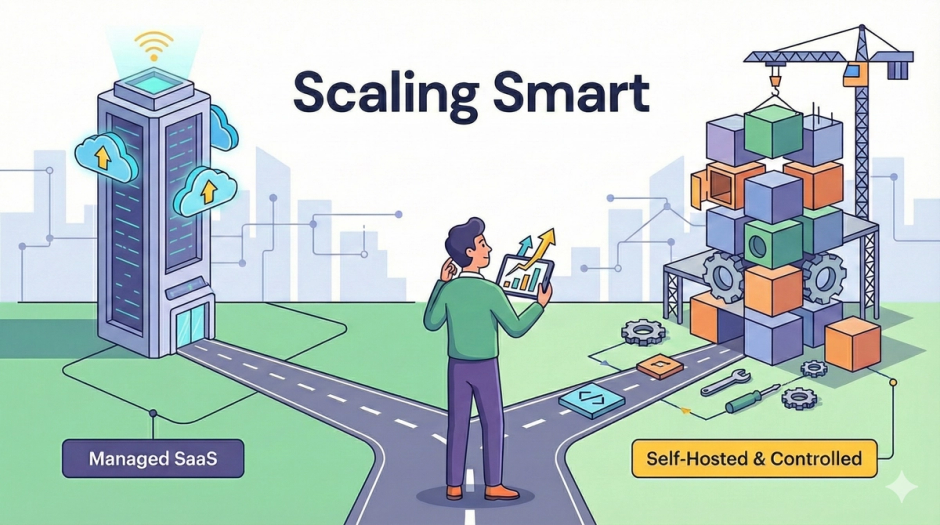
You'll end up choosing between two models. Both are valid. The trade-offs are what matter.
Approach 1: Managed SaaS Headless CMS with Enterprise Plans
Platforms like Storyblok and Sanity, combined with managed hosting like Vercel, give you a strong starting position:
- Fast onboarding,
- Polished editorial experience,
- Minimal infrastructure responsibility,
- Enterprise-grade support, SLAs, and security.
For early-stage startups, this is often the right call. Ship fast, validate the product, worry about infrastructure later.
The catch is how costs scale. Pricing on these platforms is driven by:
- Number of editors and roles,
- API usage and content volume,
- Number of environments (preview, staging, production),
- Traffic and bandwidth,
- Advanced workflows, localization, or compliance needs.
As you grow, all of these grow together. That’s when the enterprise-tier conversation begins: sometimes before you’re fully ready for it.
Storyblok Pricing
Storyblok prices by seats, spaces, and usage. The free Starter tier includes 1 seat (max 2 with a paid add-on), 1 space, and 2 locales - enough for a proof of concept.
Growth at $99/month gives you 5 included seats (max 10), 1M API requests, but still only 2 locales.
For a startup with 8–15 editors and multiple markets, you need Growth Plus at $349/month - 15 included seats, 10 locales, and more advanced scheduling and preview features.
Extra seats cost $15/month each, but the plan caps at 20 seats total - beyond that, you're in Enterprise territory (\$3,000+), which usually triggers a sales conversation rather than a self-serve upgrade. Extra locales beyond the included 10 are $20/month each. Traffic overages run $75 per 250GB.
Note: advanced custom roles, workflow stages, and release management are Premium/Elite features, not included in Growth Plus.
The jump from Growth to Growth Plus is where most teams feel the impact - and the 20-seat ceiling means fast-growing teams can hit Enterprise pricing sooner than expected.
Sanity Pricing
Sanity uses per-seat pricing. The free tier supports up to 20 users but limits you to 2 public datasets, 10K documents, and basic roles (Admin/Viewer only).
Growth at $15/seat/month unlocks 5 roles, private datasets, 25K documents, 90-day history, and collaboration features like comments and scheduled publishing.
For 12 editors, that's $180/month - reasonable on the surface. One advantage: the Growth plan supports up to 50 seats - far more generous than Storyblok's 20-seat cap.
The catches: only 2 datasets are included, and if your team chooses to isolate staging in a dedicated dataset - which is a common pattern for production-grade workflows - that's an additional $999/month per dataset.
The 25K document cap can get tight for content-heavy sites, and the Increased Quota add-on runs $299/month. SAML SSO is $1,399/month. The per-seat price looks low until you need what's behind the paywalls.
Contentful Pricing
See current Contentful pricing
Contentful deserves a separate mention. It's one of the most established headless CMS platforms, but its pricing is among the least startup-friendly. The free tier supports 10 users but caps you at 2 locales and 1 space - no staging.
Lite at $300/month gets you 20 users and 3 locales, but that's still not enough for most multi-market startups. Sandbox environments, advanced roles, and proper locale support are Premium features - custom pricing that, based on our experience with client migrations, typically falls in the $2,000–3,500/month range on an annual contract.
We've helped teams migrate away from Contentful specifically because costs outpaced the business. For a deeper look, see our Contentful vs Sanity and Storyblok vs Contentful breakdowns.
If you're evaluating content management systems today, this is one we steer most startups away from unless a specific integration or enterprise requirement demands it.
Why this matters:
Enterprise plans aren't a problem by themselves. They become a problem when you hit them by surprise: without planning for how costs grow alongside the business.
CMS Pricing Comparison for a Mid-Size Startup Site
Approximate monthly costs for a startup running a content-heavy site with 12 editors, 5+ locales, and a staging environment - a typical profile 12–18 months after launch. Prices verified against official pricing pages as of early 2026.
| Storyblok | Sanity | Contentful | Payload (self-hosted) | |
|---|---|---|---|---|
| Plan needed | Growth Plus ($349/mo) | Growth ($15/seat x 12) | Premium (Enterprise) | Free (open source) |
| CMS cost | $349/mo | \$180/mo (base seats) | $2,000–3,500/mo (est.) | \$0 |
| Staging / environments | Preview & scheduling | +$999/mo if isolated dataset | Premium only | No software fees (infra-dependent) |
| Locales | 10 included | Unlimited | Custom | Unlimited |
| Seats | 15 incl. (max 20) | Up to 50 | Custom | Unlimited |
| Hosting (Vercel Pro) | ~$60–100/mo (3–5 dev seats) | ~$60–100/mo (3–5 dev seats) | ~$60–100/mo (3–5 dev seats) | ~$150–250/mo (AWS / Vercel + managed DB) |
| Estimated total | $450–550/mo | $540–1,500+/mo | $2,100–3,600+/mo | $150–250/mo |
| Engineering overhead | Low | Low–Medium | Low | High (initial) / Medium (ongoing) |
*Sanity's range is wide because the per-seat cost is low, but if you need an isolated staging dataset (\$999/mo) or quota add-ons (\$299/mo), the total spikes significantly.
*Contentful's Premium pricing is custom - the \$2,000–3,500/mo range reflects our experience with client contracts, not official published tiers.
*Vercel Pro starts at $20/month per deploying seat; the \$60–100 estimate assumes a 3–5 person dev team.
*Payload's cost advantage comes with higher upfront engineering investment - migrations, CI/CD, and managed database setup.
Approach 2: Self-Hosted or Controlled Headless CMS
The other path is a self-hosted or controlled CMS architecture - Payload being the strongest option in this category.
This model changes how scaling works:
- Fewer platform-imposed limits,
- Costs driven by infrastructure and engineering, not pricing tiers,
- Full ownership of content and data,
- No seat-based ceilings.
Instead of paying more as usage grows inside a SaaS platform, you invest in hosting and engineering. The cost curve is flatter, but the upfront investment in technical capability is real. You need a team that knows how to run this. Production, not prototypes.
Why CMS Flexibility Matters More Than You Think
One thing you'll consistently underestimate: how often your content operations need to change.
Markets shift. You may suddenly need to:
Introduce new content types or rework existing workflows.
Add custom validation, approvals, or publishing logic.
Expand localization and translation, including market-specific variants.
Integrate content deeper into product features and other systems
With managed CMS platforms, you address these through existing features, predefined workflows, vendor roadmaps - or workarounds. The platform serves thousands of customers, so its priorities don't always align with yours. That's the trade-off you accept for the convenience.
With a controlled, self-hosted architecture, your team builds exactly what the business needs - on your timeline, not the vendor's. Custom content features ship when you need them. Workflows adapt without waiting for a platform update. Content operations align directly with business logic.
When the market moves fast, that flexibility becomes a competitive advantage. The right architecture for the problem is not the most popular one.
Choosing a CMS Architecture That Scales With Your Startup
It’s a simple question: how do you want your costs, flexibility, and operational complexity to grow as your startup scales?
- Managed enterprise platforms optimise for convenience and support.
- Controlled architectures optimise for long-term predictability and adaptability.
Neither choice is wrong. Problems arise when you pick a model early, only to realise later that your startup has outgrown the assumptions behind that decision.
Choosing the right Headless CMS for startups ensures your content, workflows, and growth scale efficiently. That architectural decision compounds over time.
CMS Migration: What to Do When Costs Outpace Growth
If you’re thinking, “We shipped quickly, but now our CMS and hosting costs are rising faster than expected,” that doesn’t mean your original decision was wrong. It usually means youre startup entered a new growth phase.
Migration sounds daunting - downtime, SEO risk, business disruption. In practice, modern headless architectures make it possible to migrate incrementally - with proper redirect mapping, URL parity, and rollout discipline, teams can safeguard SEO performance and avoid downtime.
We've done this enough times to know: with the right approach, it's a controlled transition, not a rewrite.
Scale Without CMS Lock-In
Growth inevitably drives up costs. The aim isn’t to shy away from enterprise platforms or premium tooling: it’s to select a headless CMS for startups that remains sustainable as your business scales.
Your focus is on growing the business; the CMS infrastructure should support that growth, not hinder it. Choosing a scalable, flexible headless architecture ensures content, workflows, and operations evolve alongside your startup.
FocusReactive builds and migrates headless CMS architectures for startups that have outgrown their initial setup. We've helped teams move from Contentful, Storyblok, and legacy WordPress installations to modern, cost-predictable stacks built on Payload, Sanity, and Next.js - minimizing downtime, protecting SEO performance, and avoiding the migration horror stories.
If your CMS costs are climbing faster than your revenue, let's talk about what a migration actually looks like for your stack.
Headless CMS for Startups: Scaling Without Pricing Surprises – FAQ
Answers to common follow-up questions about scaling a headless CMS for startups, focusing on cost, architecture choices, and team impact.
More posts on related topics
How to Make Your Payload CMS Site AI-Ready Right Now
Make your Next.js + Payload CMS site AI-ready: let AI crawlers in, serve raw Markdown, and wire up @graph schema to let LLMs find and cite your content.
Standalone Next.js Deployment: When Serverless Is Not an Option
Serverless vs serverful for Next.js, compare cold starts, feature support, and deployment tradeoffs across Vercel, AWS Amplify, and ECS to pick the right hosting architecture.
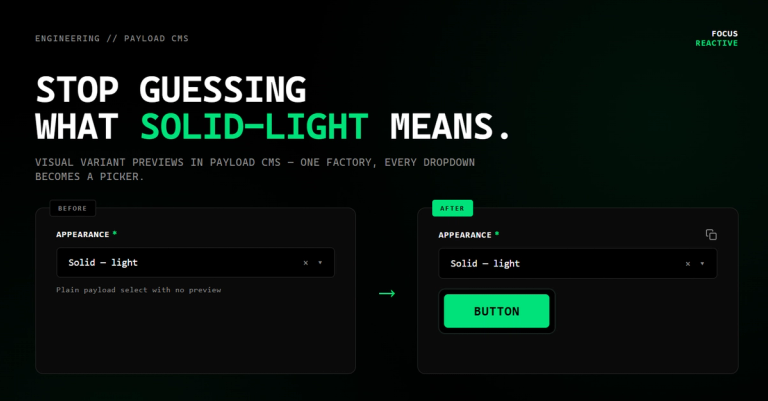
Component design preview in Payload CMS
In Payload CMS, variant dropdowns show raw values like solid-light or stats. Editors don't know what they render until they save and look. We added a small visual preview right under the dropdown that shows the matching layout as soon as it's picked. Plain Payload select underneath, around 70 lines of code.

Vercel as a Hosting Platform: Best Use Cases and Key Limitations in 2026
Vercel hosting offers a best-in-class Next.js deployment pipeline, but has real limitations at scale. Discover when to use Vercel and when to look elsewhere.
How to Migrate WordPress Site to Headless CMS in 2026
Migrate your WordPress site to a headless CMS without losing SEO traffic. Learn why teams move from WordPress, and check popular WordPress migration services in 2026.
The Best Self-Hosted Headless CMS in 2026
Self-hosted headless CMS provides unparalleled flexibility and control to marketing managers, business owners, and product owners seeking strong solutions. Check our best self-hosted headless CMS choices with clear advantages.