
From a humble two-person side project in Linz to a $138 million-funded headless CMS juggernaut, Storyblok’s rise has been nothing short of relentless. As of 2026, this fully remote powerhouse supports over 200,000 users, powers more than 500 enterprise heavyweights—including Disney and Adidas—and is actively redefining content workflows with cutting-edge AI.
But beyond the marketing hype, what do the hard numbers actually say? Whether you’re building a compelling business case for a CMS migration, analyzing API-first market trends, or hunting for verified data to cite in your next tech report, this is your definitive resource. We’ve done the heavy lifting to compile, categorize, and verify every critical Storyblok statistic for 2026. From funding milestones and a staggering 582% ROI to developer adoption and AI expansion—here is the ultimate, citation-ready breakdown of Storyblok’s market momentum.
Top Storyblok statistics for 2026
- $138M raised across four rounds, including an $80M Series C led by Brighton Park Capital in June 2024 [42].
- 200,000+ developers and marketers and about 250,000 active projects in 130+ countries, up from 74,000 users in 2022 [5, 42].
- 500+ enterprise customers, up 40% in 10 months [10].
- ~270 employees in 47 countries, with no physical HQ [55].
- $100M ARR is the stated next milestone, together with profitability [55, 56].
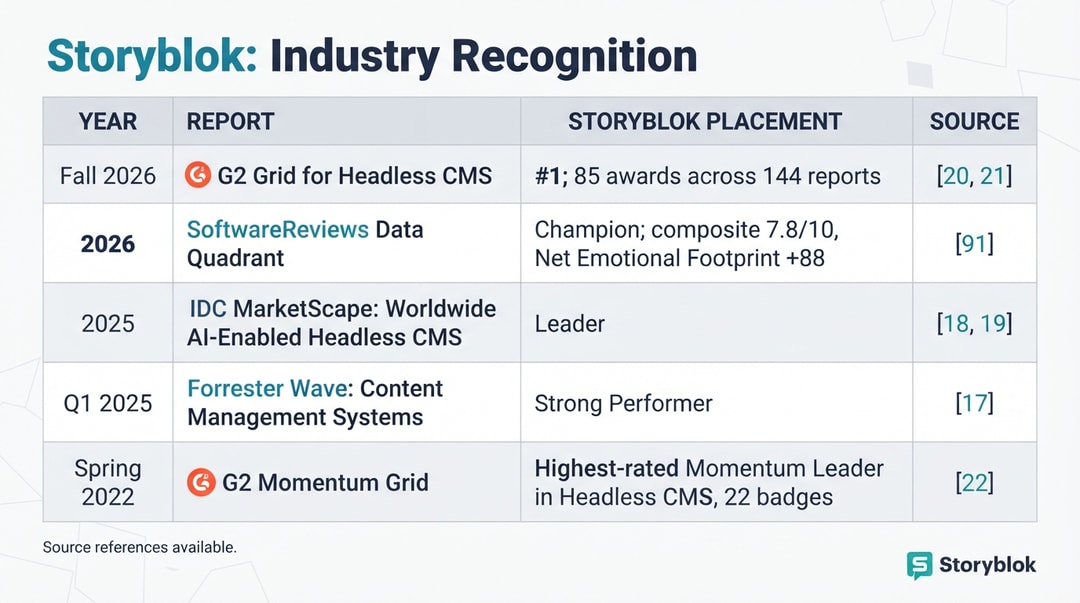
- #1 Headless CMS on the G2 Grid, Fall 2026, with 85 G2 awards [20]; 4.5/5 from ~596 G2 reviews [21].
- Leader in the IDC MarketScape for AI-enabled headless CMS 2025 [18] and a Strong Performer in the Forrester Wave CMS Q1 2025 [17].
- 582% ROI over three years, payback under 6 months, per a Storyblok-commissioned Forrester TEI study [23].
- 1.54M monthly npm downloads for
storyblok-js-client, up 71% year over year [93]. - ~10,400 companies use Storyblok, #2 in API-first CMS with a 25.3% share behind Contentful [78].
Storyblok company statistics
Storyblok was founded in 2017 in Linz, Austria, by Dominik Angerer (CEO) and Alexander Feiglstorfer (CTO). The first prototype was built around 2015 while both founders worked at an agency, and the company reached $1M ARR bootstrapped, with just the two founders [57].
- Profitable in year one: the company was founded in September 2017, was profitable by October with 1,000+ users and passed €1M revenue by end of 2019 [53].
- Remote since day one: Linz is the registered HQ, but there is no physical headquarters [55]; the team spans 45+ countries and 47+ nationalities [2].
- US entity: Storyblok Inc. (Delaware) started on 1 January 2024 [52]; other listed offices are Vienna and Wilmington [71].
- Leadership hires: Mark Wheeler as CMO (Aug 2024) [9] and Joe Vranicar as CRO (Dec 2025) [10]; COO Barbora Winczerova previously invested in Storyblok for Mubadala Capital [1].
- Partner network: Storyblok’s partner directory lists 327 solution partners (October 2026) [33].
- Cloud partner recognition: AWS Rising Star Technology Partner of the Year 2025 for the Alps region [34].
Key milestones
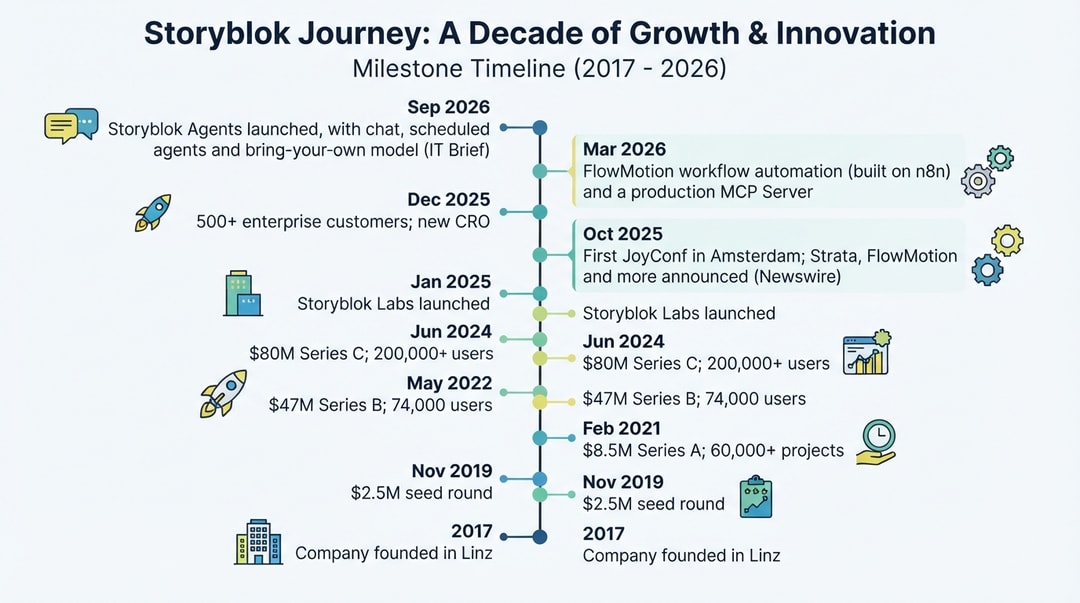 storyblokmilestones
Key milestones of Storyblok
Storyblok funding and valuation statistics
Storyblok has raised $138M in four rounds since 2019 [1, 42]. The Series C was an up round and Brighton Park Capital’s arrival made it Storyblok’s first US lead investor.
| Round | Date | Amount | Lead investors | Sources |
|---|---|---|---|---|
| Series C | 4 Jun 2024 | $80M (€74M) | Brighton Park Capital; HV Capital, Mubadala, 3VC, firstminute joined | [7, 44, 47, 48, 50] |
| Series B | 17 May 2022 | $47M (€43M) | Mubadala Capital and HV Capital | [5, 43, 45] |
| Series A | 4 Feb 2021 | $8.5M (€7.08M) | Mubadala Capital | [4, 46, 49] |
| Seed | 27 Nov 2019 | $2.5M | firstminute capital and 3VC; Founders Factory joined | [3] |
- Total funding by source: $138M [64, 66, 68], $138.43M [65], $138.1M [69] and $138.2M [70]. The gaps come from currency conversion and rounding.
- Valuation: not disclosed; the Series C was an up round [42]. The CEO has called valuations “pretty much irrelevant” to the company [52].
- No new equity planned after the Series C: Storyblok rebuffed takeover approaches, was in debt talks with JPMorgan and HSBC, and sees an exit or IPO in 5–10 years [54].
- Use of Series C funds: US expansion and AI features for non-technical users [42, 51].
Storyblok revenue and growth statistics
Storyblok does not publish revenue; the best public signal is “eight-figure ARR” with a stated goal of $100M ARR and profitability [55]. Third-party estimates vary widely, so treat them as rough ranges.
| Source | Estimate | Note |
|---|---|---|
| GetLatka | $2.9M (2021), $18.1M (2022), $29.7M (2023), $49.2M (Oct 2024), $80M (Nov 2024) | The $80M figure matches the Series C amount and its cited PR Newswire release [58] states no revenue, so treat it as unverified [64] |
| Seedtable | $28–74M | Range estimate [67] |
| SaaS Club podcast | “Eight-figure ARR” | From the CEO; undated, likely 2023 [57] |
- Revenue mix: about 70% enterprise and 30% self-serve, with 3x+ year-over-year growth and ~3% enterprise churn at the time of the interview [57].
- US share: just under 20% of revenue in June 2024 [52]; the target is 50%, after revenue “tripled or quadrupled” recently [53].
- US is the fastest-growing market, per Storyblok in 2023 [8].
- Enterprise growth: enterprise client growth rose six-fold in 2020 [4] and enterprise customers grew 40% in 10 months to 500+ in 2025 [10].
- Profitability: the CEO expected to be roughly profitable by the end of 2025 [42], and the Series C is meant to carry the company to break-even [54].
Storyblok customer and adoption statistics
Storyblok counts users and projects rather than paying customers; its only stated customer figure is 500+ enterprise customers [10]. User numbers almost tripled between 2022 and 2024.
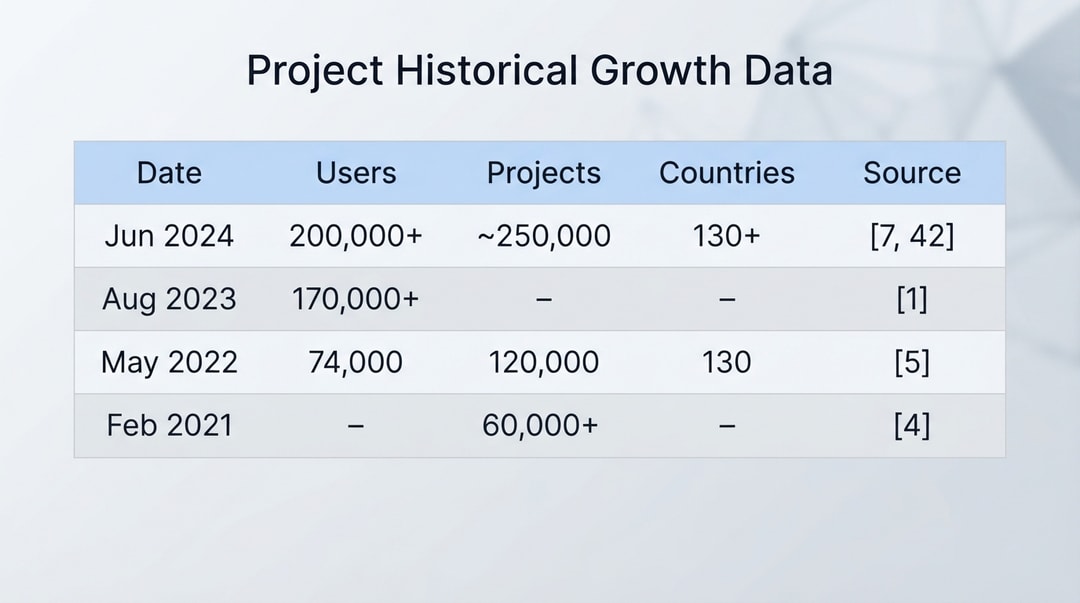 vendor-reported-milestones
Vendor-reported user milestones
- Notable customers: Logos on Storyblok’s site include Disney, Netflix, Oatly, Marc O’Polo, Renault, Adidas, Autodesk and Virgin Media O2 [21, 27]. Adidas, T-Mobile, Renault and Oatly are named in the Series C release [7]; TomTom and Octopus Energy in the AWS award release [34].
- Top sites on Storyblok include
shop-apotheke.com,blackberry.com,nice.org.ukandfielmann.de[76].
Market share and website usage (Trackers measure different things—sites vs. companies vs. domains—so compare within a source, not across them.)
Вот классическая таблица в формате Markdown для этих данных:
| Tracker | Storyblok count | Share / rank | Source |
|---|---|---|---|
| TechnologyChecker | ~10,631 live domains (7,845 in Jun 2026) | #2 headless CMS behind Sanity; #58 overall CMS | [80] |
| 6sense | ~10,451 companies | 25.28% of API-first CMS, #2 behind Contentful (44.16%) | [78] |
| Enlyft | 8,263 companies | ~0.1% of CMS | [79] |
| wmtips | ~2,034 sites | 0.1% of CMS, #23 CMS | [77] |
| W3Techs | – | <0.1% of websites with a known CMS | [76] |
- Top countries: the US, Germany, the Netherlands and the UK lead in every tracker. wmtips: US 18.2%, Germany 15.3%, Netherlands 9.8%, UK 9.7%, Sweden 6.5% [77]; 6sense: US 22.3%, Germany 19.3%, UK 13.3% [78].
- Company size: 61% of Storyblok companies have fewer than 50 employees and 10% have more than 1,000 [79].
- Stack: 48% of Storyblok domains run Next.js and 34% are hosted on Vercel; 320 domains moved from WordPress to Storyblok vs. 70 the other way [80].
- US momentum: just under 20% of revenue came from the US in 2024 [52].
Storyblok team and employee statistics
Storyblok employs about 270 people in 47 countries [55], up from 36 in 2020, with almost all of the growth in 2021–2023.
[embed: node/e2669629-b7d1]
- Series B to Series C: the team grew 500% between February 2021 and May 2022, to 171 people in 38 countries [5]; by June 2024 it had about 240 staff in 45 countries [7], 72 of them in product development [53].
- Other 2025–2026 counts: 280 [66], 278 [68], 240 [72], 218 [74] and 350 [75]. The CEO’s own figure of 270 [55, 56] is the most reliable.
- Growth outlook: see Built In’s company profile and the Storyblok careers page [2, 72].
Storyblok market position and analyst recognition
Storyblok is a Leader in IDC’s AI-enabled headless CMS MarketScape and a Strong Performer in Forrester’s CMS Wave, in a headless CMS market growing about 19–21% a year.
 storyblok-market-position
Headless CMS market size
| Research firm | Market size | Forecast | CAGR | Source |
|---|---|---|---|---|
| Mordor Intelligence | $1.82B (2026) | $4.42B by 2031 | 19.4% | [81] |
| Market Research Future | $3.95B (2025) | $26.66B by 2035 | 21.04% | [82] |
| The Business Research Company (commerce) | $2.55B (2026) | $5.49B by 2030 | 21.1% | [83] |
The wider CMS market is put at $30.91B in 2025, rising to $45.71B by 2030 [84]. More context is in our 60+ headless CMS statistics for 2026 [85].
Storyblok vs. competitors
 storyblok-vs-competitors
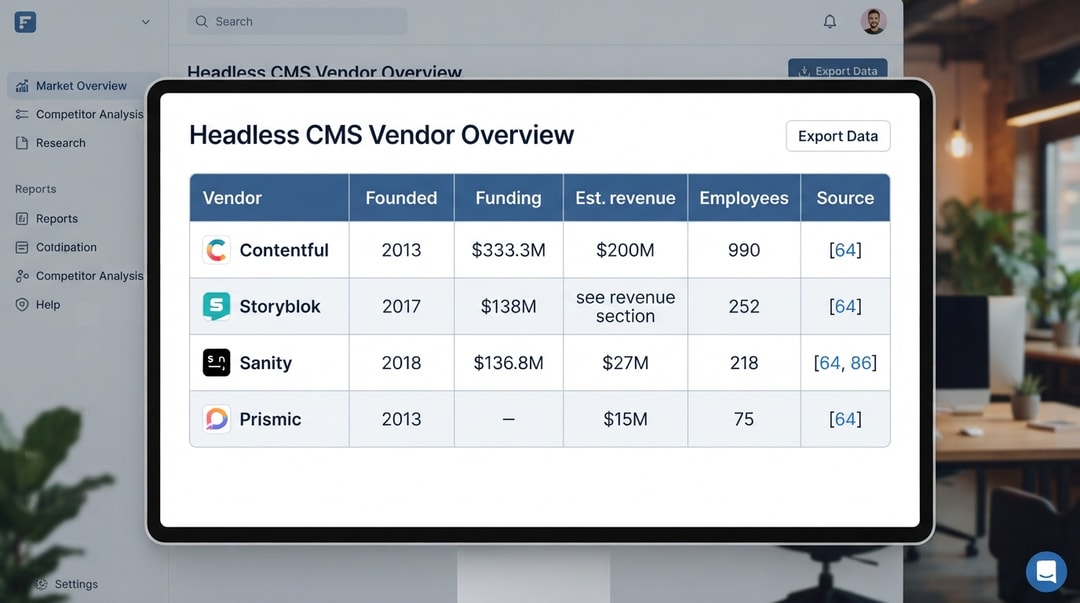
(GetLatka figures are third-party estimates as of December 2024).
Storyblok developer ecosystem, AI and pricing statistics
Storyblok’s seven main JavaScript SDKs were downloaded about 4.7M times in the last 30 days, roughly double a year earlier.
In absolute terms Storyblok is still smaller on npm than its biggest rivals. In the same 30-day window @sanity/client had 14.07M downloads (+291%), contentful 4.97M (+17.5%), payload 3.95M (+442%), @strapi/strapi 0.92M (+41%) and @prismicio/client 0.86M (+22%) [93, 94].
- SDKs, GitHub and integrations: 29 official libraries: 18 JavaScript, 4 PHP, 3 Swift and 4 Kotlin [40]. Monorepo: the JavaScript SDKs now live in
storyblok/monoblok; archived repos keep their stars, e.g.storyblok(328),storyblok-nuxt(295),storyblok-astro(213) andstoryblok-react(138) [95, 96]. - App directory: roughly 50–75 apps in 15 categories [41]; FlowMotion adds 500+ integrations [13].
AI feature timeline
| Date | Launch | Source |
|---|---|---|
| Sep 2026 | Storyblok Agents: in-CMS chat, scheduled custom agents, bring-your-own model | [60] |
| Mar 2026 | FlowMotion (managed n8n, enterprise add-on) | [13] |
| Mar 2026 | Production MCP Server for Claude, Cursor and other clients | [14] |
| Oct 2025 | Strata vector data layer announced (early access 2026) | [16] |
| Sep 2025 | AI translations, AI SEO, alt text, custom AI tokens, AI Branding | [15] |
| Jun 2024 | Ideation Room (beta), Storyblok’s first AI tool | [42] |
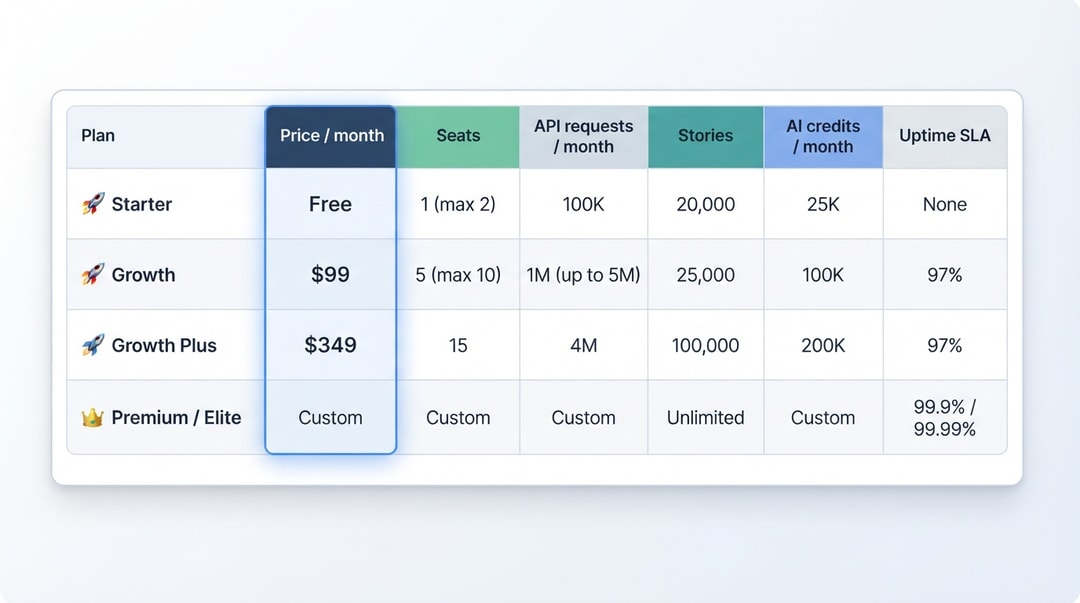
Pricing (October 2026) [35]
 storyblok-plans
(Source: Storyblok pricing. Extra seats cost $15/month and extra locales $20/month on Growth).
Infrastructure and security
- Hosting: AWS with a global CDN; TLS 1.3 in transit, AES-256 at rest; ISO 27001 and TISAX certified [36].
- SLA: up to 99.99% on the Elite plan, with service credits for enterprise [37]; live status at uptime.storyblok.com.
- Data regions: EU, US, Australia, Canada and China [38].
- Rate limits: 1,000 requests/second for cached CDN calls; 50/second for uncached single entries [39].
Storyblok reviews, ROI and case study statistics
Storyblok scores 4.3–4.5 out of 5 on every major review site, and its commissioned Forrester study claims a 582% three-year ROI.
Review ratings (October 2026)
| Platform | Rating | Reviews | Source |
|---|---|---|---|
| G2 | 4.5 / 5 | ~596 | [87] |
| Gartner Peer Insights | 4.5 / 5 | 190 ratings (217 reviews); 53% five-star | [88] |
| OMR Reviews | 4.4 / 5 | 108 | [92] |
| Capterra | 4.3 / 5 | 14; ease of use 4.4, support 4.6 | [89] |
| Software Advice | 4.3 / 5 | 14 | [90] |
| SoftwareReviews | 7.8 / 10 | 52 | [91] |
Forrester Total Economic Impact (commissioned by Storyblok, March 2023)
- 582% ROI over three years and payback in under 6 months [23, 62].
- $1.6M net present value and a 3x productivity gain for a composite company with $800M revenue, 5,000+ employees, 250 developers and 250 content creators [23].
Published customer outcomes
- Virgin Media O2: £2M+ saved per year; 6,000+ pages migrated; 10,000+ editors and agents across 200+ stores [28].
- Lumion: 4x faster site; conversions +41%; traffic +40% [29].
- Dojo: Content ops 2x faster; site 150% faster; web sessions +66% YoY; 600+ pages migrated in 4.5 months [63].
- EnergySage: Time to market 50% faster; landing page in ~2 hours; 4,000+ pages moved [31].
- Spendesk: Page creation time −80%; CMS up to 2x faster; codebase 25% smaller [32].
- Oatly: 16 regional sites launched in about two months [30].
Storyblok survey data
- State of CMS 2024 (1,719 respondents): 99% of companies that switched to headless report improvements; 81% use more than one CMS; 74% of non-headless users plan to switch within two years [24].
- State of CMS 2025 (1,300 respondents): 44% want more AI-powered content creation; 61% manage two or more CMSs; US marketers on modern systems earn 85% more [25, 26].
- FlowMotion survey 2026: 75% of marketers spend 6+ hours a week on content coordination; 88% of developers say new automations take more than a week [13].
Final thoughts: what the Storyblok data says
Storyblok is the strongest European challenger in headless CMS: second to Contentful by company count, #1 on G2’s Headless CMS Grid, and doubling SDK usage year over year. Its edge is the visual editor for marketers, which shows in high review scores and enterprise wins such as Virgin Media O2. The open questions are revenue (no verified figure yet), the pace of the US push, and whether new AI products like Storyblok Agents and FlowMotion turn into sustained usage. Vendor figures above are self-reported; third-party trackers disagree, so cite the source with every number.
At FocusReactive we build and migrate Storyblok projects for enterprise teams. If you’re weighing Storyblok against Sanity or Contentful, compare it with our Sanity CMS statistics report [86] and 60+ headless CMS statistics for 2026 [85].
Full list of sources
Storyblok (company releases and pages)
- Storyblok – About
- Storyblok – Careers
- Seed round: $2.5M from firstminute and 3VC
- Series A press release
- Series B press release
- Series B announcement
- Series C press release
- Storyblok record growth in the US
- Mark Wheeler appointed CMO
- Joe Vranicar appointed CRO
- Storyblok Labs launch
- JoyConf 2025 product announcements
- FlowMotion launch and survey
- MCP Server
- AI features
- Strata
- Forrester Wave CMS Q1 2025
- IDC MarketScape Leader
- IDC MarketScape report page
- G2 at Storyblok
- G2 reviews landing page
- G2 Momentum Leader 2022
- Forrester TEI study
- State of CMS 2024
- State of CMS 2025 press release
- State of CMS 2025 full report (PDF)
- Case studies
- Virgin Media O2
- Lumion case study
- Oatly case study
- EnergySage
- Spendesk
- Solution partners directory
- AWS Rising Star 2025
- Pricing
- Security
- Service level
- Data regions FAQ
- Content Delivery API rate limits
- Official libraries
- App directory
Press and interviews
- TechCrunch – Series C (2024)
- TechCrunch – Series B (2022)
- tech.eu – Series C
- tech.eu – Series B
- tech.eu – Series A
- CMSWire – Series C
- SiliconANGLE – Series C
- Silicon Canals – Series A
- AIN – Series C
- startbase – Series C
- Trending Topics – US expansion
- trend.at – company profile
- ION Analytics – takeover approaches
- SaaStock – Scaling Storyblok
- YouTube – The SaaS Revolution Show with Dominik Angerer
- SaaS Club podcast #366
- PR Newswire – Storyblok news
- Newswire – JoyConf 2025
- DestinationCRM – Storyblok Agents
- IT Brief – Storyblok Agents
- B&T – Forrester TEI
- Finextra – Dojo
Company data and estimates
- GetLatka
- CB Insights
- PitchBook
- Seedtable
- Caplight
- Clera
- Private Market View
- Craft
- Built In – profile
- Built In – growth and stability
- Employbl
- ATDb
Usage trackers and market research
- W3Techs – Storyblok
- wmtips
- 6sense
- Enlyft
- TechnologyChecker
- Mordor Intelligence – headless CMS market
- Market Research Future – headless CMS market
- The Business Research Company via National Law Review
- Landbase – CMS market share statistics
- FocusReactive – 60+ headless CMS statistics for 2026
- FocusReactive – Sanity CMS statistics 2026
Reviews
Developer data