AI is no longer just an assistant; it is the default engine powering how the modern web is built, scaled, and migrated. By 2026, the technology has evolved from simple chat prompts to autonomous agents that write code, execute tasks, and move entire CMS architectures.
But a fascinating paradox has emerged: while nine out of ten developers now use AI at work, trust in its output is plummeting. Measured productivity gains are trailing far behind the hype, and AI agents are completely changing the nature of web traffic.
This report synthesizes developer surveys, controlled productivity studies, code-quality research, traffic data, and real-world CMS migration projects to map exactly what AI means for web development in 2026.
(Note: Using these statistics? If you cite this data in your own article or report, please credit this research and add a backlink to our site.)
Top AI in Web Development & CMS Migration Statistics for 2026
- Massive Adoption: A staggering 90% of professional developers used AI coding agents at least weekly between May and July 2026, with 68% relying on them daily (11).
- The AI Code Takeover: 75% of all new code at Google is now AI-generated and engineer-approved—up from 50% in late 2025 (18, 19). Across the broader industry, web developers report a median of 63% AI-generated code (13).
- The Trust Gap: Despite massive adoption, 46% of developers actively distrust the accuracy of AI output (up from 31% last year). Only 3.1% highly trust it (1).
- The Speed Illusion: Experienced open-source developers were actually 19% slower when using early-2025 AI tools, yet they believed they were 20% faster (25). Follow-up studies in 2026 point to only a marginal, statistically insignificant speedup for complex tasks (26).
- Security Stagnation: AI-generated code passes security tests only 56% of the time. This failure rate hasn’t improved despite four testing rounds and over 100 newer models (41).
- The Rise of AI Web Builders: Lovable passed a massive $500M revenue run-rate in June 2026 (55), while Vercel’s v0 surpassed 3.5 million users (51, 52).
- The Non-Human Web: More than half of all Internet traffic is now non-human. Daily AI-agent server requests have skyrocketed by over 1,700% year-over-year (65).
- Unlocking CMS Migrations: AI is shrinking migration timelines. Airbnb moved ~3,500 test files in 6 weeks instead of an estimated 1.5 years (103). FocusReactive successfully migrated 16,500 pages from Storyblok to Payload in just 8 weeks with zero URL changes (129).
- The SEO Risk Remains: A migrated domain takes an average of 523 days to recover its old organic traffic, and 17% never recover within 1,000 days (96).
- Market Forecast: Analysts predict 90% of enterprise software engineers will use AI code assistants by 2028, a massive leap from under 14% in early 2024 (117).
The Adoption Wave: How Developers Use AI in 2026
Every major developer survey from 2025 to 2026 points to the same reality: regular AI use sits comfortably between 84% and 90%. The narrative shift in 2026 isn’t about whether developers use AI, but how they use it—moving from passive chat assistants to autonomous coding agents.
Table 1:
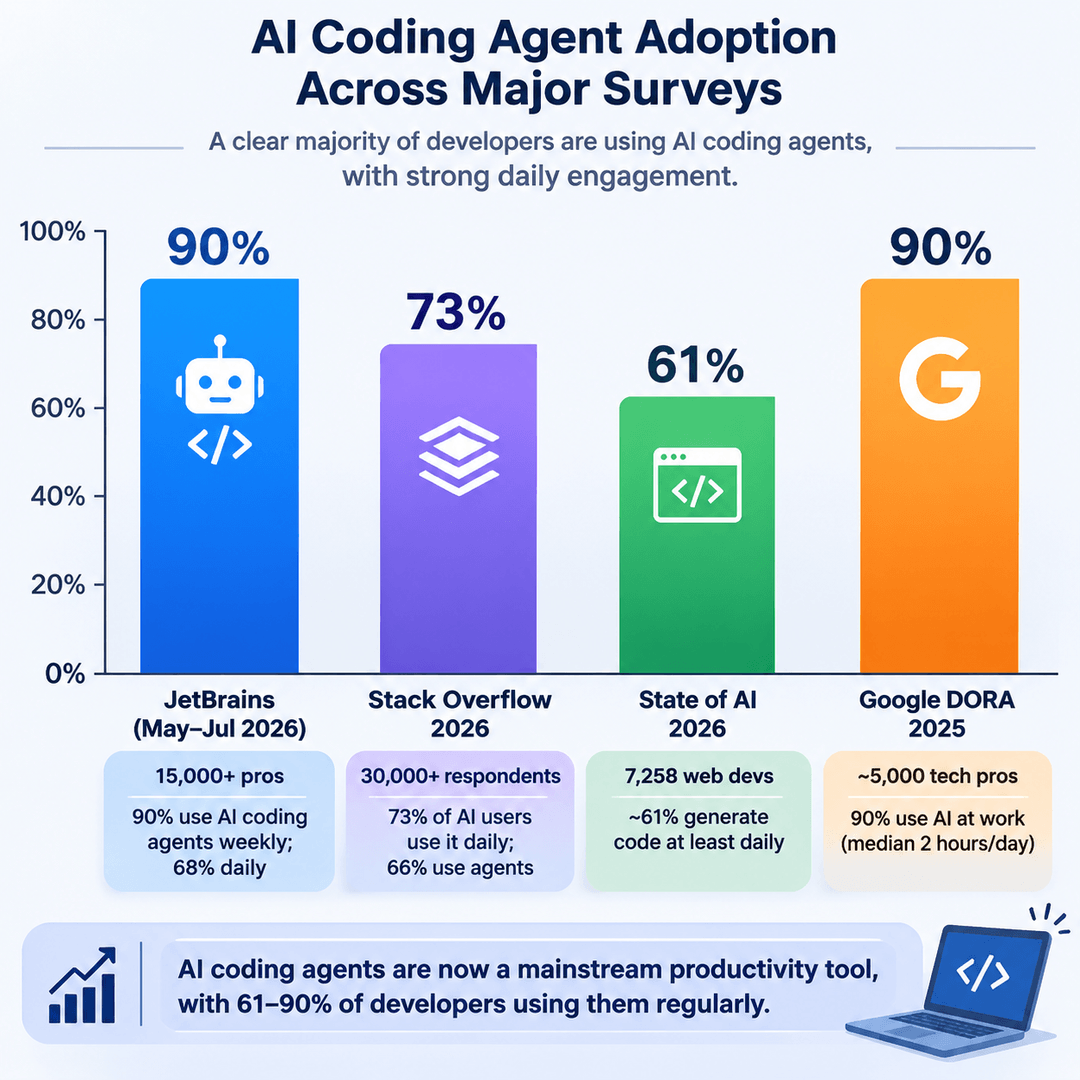 AI-adoption
AI Adoption Across Major Developer Surveys
- Power Users: Nearly a third (30.9%) of AI users spend 4+ hours a day working alongside AI, and another 24.1% spend 2–4 hours (4).
- The “Vibe Coding” Shift: In 2025, 72.2% of developers firmly stated “vibe coding” (using AI to code via natural language without deep programming knowledge) was not part of their professional work (1). By 2026, 66% of AI users are happily running coding agents (4).
- What They Actually Do: 69.3% use AI to generate code in familiar stacks, 63.8% for debugging, and 58.1% for writing tests. Only 20% trust AI to deploy or operate production systems (4).
- Peer Pressure: 68% of developers expect employers to mandate AI proficiency soon (9). Interestingly, 41% admit to using AI more than necessary just because they feel expected to, even though only 17% of companies have a clear AI strategy (16).
How Much Code Is Actually Written by AI?
The amount of code authored by language models is staggering. Google reports that 75% of new code is AI-generated and approved by engineers, up from 50% just a few months prior (18, 19). Microsoft’s Satya Nadella noted in 2025 that 20–30% of code in Microsoft’s repositories was “written by software” (20).
Developers estimate that 47% of their code is written fully by agents, 38% with some AI help, and only 27% strictly by hand (12). Web development is ground zero for this shift. Web developers report a median of 63% AI-generated code, though they refactor a median of 50% of it before deploying (13). According to Anthropic, JavaScript, TypeScript, HTML, and CSS make up roughly 59% of all coding queries sent to Claude (22).
The Productivity Paradox: Vibe Coding vs. Reality
Developers feel incredibly fast with AI, but controlled telemetry tells a different, sobering story. Gains on paper often evaporate in review queues and rework.
Table 2: Measured AI Productivity vs. Perception
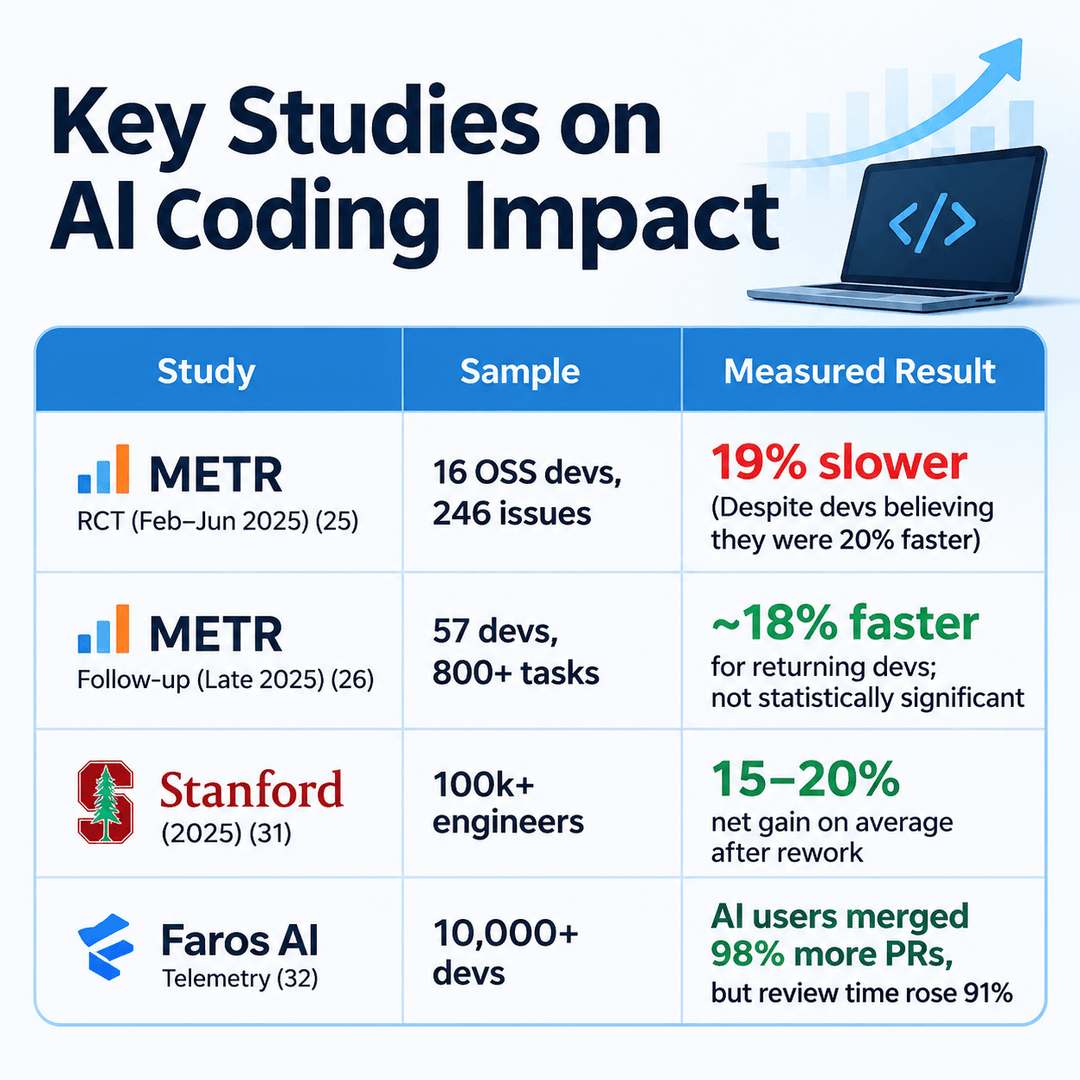 AI Productivity
- The Complexity Cliff: Stanford found a 31% speed boost on simple, greenfield tasks, but only a 7% gain on complex, legacy codebases. Their rule of thumb for hard brownfield work (like CMS migrations) is a meager 0–10% speed gain (31).
- Acceleration Whiplash: High-AI teams completed 33.7% more tasks, but actually shipped 11.7% fewer deployments per week because of bottlenecks in review and QA (33).
- Code Quality Crisis: Developers are now ~5x more likely to copy/paste than properly refactor (37). AI-assisted PRs feature 1.7x more logic errors and 3x more readability issues (39).
AI Web Builders and the “Non-Human Web”
The fastest-growing software companies in history are now AI app builders, and their primary users aren’t even developers. At the same time, AI crawlers are changing how websites are consumed.
- The Build Economy: Lovable passed a $500M revenue run-rate by June 2026, with 80% of its users sitting in non-technical roles (55, 57). Vercel’s v0 hit 3.5M+ users, and 30% of all apps running on Vercel now originate from AI agents (51, 52).
- Claude Takes the Crown: Claude Code has overtaken GitHub Copilot as the most-used AI tool at work in 2026, used by 47% of US developers (11).
- The Internet’s Second Audience: Cloudflare reports that daily AI-agent requests grew 1,700%+ YoY. AI training and agent scraping now make up over half of all internet traffic (65).
- The JavaScript Blind Spot: Only Googlebot/Gemini and AppleBot render JavaScript consistently. Claude and ChatGPT crawlers hit 404s on roughly 35% of client-rendered sites. Server-rendered HTML now matters just as much for AI visibility as it does for traditional SEO (54).
AI in CMS Platforms & Automated Migrations
Every major CMS has shipped AI agents or Model Context Protocol (MCP) servers, but sustained usage is rare. Teams love the idea of AI content automation, but struggle to keep it running.
- The Sanity Agent Boom: Sanity’s MCP server saw monthly AI tool calls explode from 7,400 to 521,000 in just eight months (79). However, their telemetry shows a massive drop-off: out of 9,472 users exploring AI, only 8% sustained their workflows. The culprit? Sanity attributes 64% of automation failures to messy, poor schema architectures (80). You cannot automate a broken foundation.
- AI-Assisted Migrations: AI is successfully slashing CMS migration timelines by up to 95%—if the work is repetitive and verifiable.
-
- FocusReactive moved 16,500 pages from Storyblok to Payload in 8 weeks utilizing a single engineer, maintaining 100% URL parity (129).
- Salesforce used AI to cut a 2-year legacy package migration down to 4 months (109).
- Ona migrated their CMS to MDX files in 6 hours (including 3 hours of human review), a task estimated to take 3 weeks manually (111).
- The SEO Baseline to Beat: Migrations are incredibly risky. Without pixel-perfect parity and strict URL management, domains take an average of 523 days to recover organic traffic. 17% never recover (96).
Final Thoughts & How to Act on This Data
AI is undeniably writing the majority of new web code, but the data clearly highlights where it breaks down: complex legacy codebases, stringent security requirements (stuck at a 56% pass rate), and unverified CMS migrations. AI does not remove the need for engineering verification—it makes verification the main job.
Three takeaways for teams planning a website or CMS move in 2026:
- Define “Done” Before AI Writes Code: Every successful AI migration pairs generation with automated, programmatic checks against the live system.
- Treat AI Crawlers as a Primary Audience: Most bots do not run JavaScript. Clean structured data and server-rendered pages are critical for AI visibility.
- Fix Your Schema First: Only 8% of teams sustain AI content workflows. If your architecture is messy, AI will only scale the chaos.
If you are planning a migration, FocusReactive runs AI-assisted CMS migrations built entirely on a verification harness—checking every single page against the live site, with every change reviewed by a senior engineer. We deliver a scoped proposal within two days, not two months.
Full List of References & Sources
Developer surveys and adoption
- Stack Overflow, “2025 Developer Survey Reveals Trust in AI at an All Time Low” — stackoverflow.co
- Stack Overflow, “2025 Developer Survey: AI” — survey.stackoverflow.co/2025/ai
- Stack Overflow Blog, “The results of the 2026 Developer Survey are here” — stackoverflow.blog
- Stack Overflow, “2026 Developer Survey” — survey.stackoverflow.co/2026
- Stack Overflow, “2026 Developer Survey: AI” — survey.stackoverflow.co/2026/ai
- Google, “How are developers using AI? Inside our 2025 DORA report” — blog.google
- Google Cloud, “Announcing the 2025 DORA Report” — cloud.google.com
- Google Cloud, “Announcing the 2024 DORA report” — cloud.google.com
- JetBrains, “The State of Developer Ecosystem 2025” — blog.jetbrains.com
- JetBrains, “Which AI Coding Tools Do Developers Actually Use at Work?” — blog.jetbrains.com
- JetBrains, “AI Coding Agents: Adoption Trends” — blog.jetbrains.com
- JetBrains, “How Much Code Do Developers Really Let Agents Write?” — blog.jetbrains.com
- Devographics, “State of AI 2026: Usage” — 2026.stateofai.dev
- Devographics, “State of JavaScript 2025: Usage” — 2025.stateofjs.com
- GitHub, “Octoverse 2025” — github.blog
- Atlassian, “State of Developer Experience 2026” — atlassian.com
- Atlassian, “AI adoption is rising, but friction persists” (2025) — atlassian.com
- Google, “Sundar Pichai shares news from Google Cloud Next 2026” — blog.google
- Google, “Alphabet Q3 2024 earnings call: CEO remarks” — blog.google
- TechCrunch, “Microsoft CEO says up to 30% of the company’s code was written by AI” — techcrunch.com
- Sonar, “Sonar Data Reveals Critical Verification Gap in AI Coding” — sonarsource.com
- Anthropic, “Economic Index: AI’s impact on software development” — anthropic.com
- Anthropic, “Economic Index report: Economic primitives” (Jan 2026) — anthropic.com
- Anthropic, “Economic Index report: Cadences” (Jun 2026) — anthropic.com
Productivity, quality and security
- METR, “Measuring the Impact of Early-2025 AI on Experienced Open-Source Developer Productivity” — metr.org
- METR, “We are Changing our Developer Productivity Experiment Design” — metr.org
- METR, “Analyzing coding agent transcripts to upper bound productivity gains” — metr.org
- Google, “How much does AI impact development speed? An enterprise-based RCT” — arxiv.org
- Peng et al., “The Impact of AI on Developer Productivity: Evidence from GitHub Copilot” — arxiv.org
- MIT Economics, “The Effects of Generative AI on High-Skilled Work” — economics.mit.edu
- Stanford / AI Engineer World’s Fair, “Does AI Actually Boost Developer Productivity? (100k Devs Study)” — ai.engineer
- Faros AI, “The AI Productivity Paradox” — faros.ai
- Faros AI, “The Acceleration Whiplash” — faros.ai
- Bain & Company, “From Pilots to Payoff: Generative AI in Software Development” — bain.com
- Harness, “Harness Report Reveals AI Velocity Paradox” — harness.io
- GitClear, “AI Copilot Code Quality: 2025” — gitclear.com
- GitClear, “The Maintainability Gap: 2026 AI Code Quality Research” — gitclear.com
- GitClear, “Write-only mode” research — gitclear.com
- CodeRabbit, “State of AI vs Human Code Generation Report” — coderabbit.ai
- GitHub, “Does GitHub Copilot improve code quality?” — github.blog
- Veracode, “LLMs Are Getting Smarter But Not Safer” (2026) — veracode.com
- Veracode, “AI-Generated Code Poses Major Security Risks” (2025) — veracode.com
- Apiiro, “4x Velocity, 10x Vulnerabilities” — apiiro.com
- Perry et al., “Do Users Write More Insecure Code with AI Assistants?” — arxiv.org
- DevClass, “AI assistants write insecure code that humans trust too much” — devclass.com
AI tools, web development and traffic
- Anthropic, “Anthropic raises $30B Series G” — anthropic.com
- Anthropic, “Anthropic acquires Bun as Claude Code reaches $1B” — anthropic.com
- Cursor, “Past, Present, and Future” (Series D) — cursor.com
- Cursor, press posts — cursor.com
- Microsoft, “2026 Annual Report: Shareholder Letter” — microsoft.com
- Vercel via Business Wire, “$300M Series F” — businesswire.com
- TechCrunch via Yahoo Finance, Vercel ARR and AI agents — finance.yahoo.com
- Vercel, “AI Gateway Production Index, July 2026” — vercel.com
- Vercel, “The rise of the AI crawler” — vercel.com
- Tech.eu, “Lovable becomes fastest software company ever to reach $100M ARR” — tech.eu
- The Next Web, “Lovable build economy, $500M ARR” — thenextweb.com
- Lovable, “A first look at the build economy” — lovable.dev
- TechCrunch, “Replit hits $3B valuation on $150M annualized revenue” — techcrunch.com
- Built In, “Replit raises $400M Series D at $9B valuation” — builtin.com
- Growth Unhinged, “How Bolt.new hit $40M ARR in 5 months” — growthunhinged.com
- Figma, “Figma’s 2025 AI report” — figma.com
- WP Engine, “AI Agency Trends Report” — wpengine.com
- Webflow, “2026 State of the Website” — webflow.com
- HubSpot, “Website Marketing Report 2025” — blog.hubspot.com
- Cloudflare, “The Internet has a second audience” — blog.cloudflare.com
- Cloudflare, “Content Independence Day, one year on” — blog.cloudflare.com
- Cloudflare, “The crawl-to-click gap” — blog.cloudflare.com
- Cloudflare, “2025 Radar Year in Review” — blog.cloudflare.com
- FocusReactive, “SEO Website Migration Checklist” — focusreactive.com
- Adobe, “AI-driven traffic surges across industries” — business.adobe.com
CMS platforms and AI content
- Storyblok, “State of CMS 2025” — storyblok.com
- IT Brief, “Storyblok launches Agents to automate content tasks” — itbrief.co.uk
- Contentful via Business Wire, marketing AI survey — businesswire.com
- Contentful, “A New Chapter for Contentful” — contentful.com
- Contentful, “AI statistics every digital team should know” — contentful.com
- FocusReactive, “60+ Headless CMS Statistics for 2026” — focusreactive.com
- Ahrefs, “Marketers’ AI content creation” — ahrefs.com
- HubSpot, “AI Trends for Marketers Report” — blog.hubspot.com
- Sanity, “Agents leave receipts. We read 1.46 million of them” — sanity.io
- Sanity, “AI Content Operations Report” — research.sanity.io
- Sanity, “loveholidays customer story” — sanity.io
- Sanity, “Content Agent: days of work in one conversation” — sanity.io
- Sanity / Forrester, “Total Economic Impact study” — sanity.io
- Moving Primates, “Figma swallows headless CMS Payload” — movingprimates.de
- Strapi, “Bye 2025, hello 2026: a year in review” — strapi.io
- Make WordPress, “Big Picture Goals for 2026” — make.wordpress.org
- Anthropic, “Donating the Model Context Protocol” — anthropic.com
- MCP Blog, “MCP joins the Agentic AI Foundation” — blog.modelcontextprotocol.io
- Forrester, “Analyst Takes For Digital Content In 2026” — forrester.com
Migration and replatforming
- McKinsey, “Delivering large-scale IT projects on time, on budget, and on value” — mckinsey.com
- strategy+business, “Why do large projects go over budget?” — strategy-business.com
- OpenCommons, “CHAOS Report on IT Project Outcomes” — opencommons.org
- FocusReactive, “How Much Does an Enterprise CMS Migration Cost in 2026?” — focusreactive.com
- Pantheon, “What Website Replatforming Costs, Takes and Risks” — pantheon.io
- Agility CMS, “Website Replatform Dilemma” — agilitycms.com
- Search Engine Journal, “How Long Should An SEO Migration Take?” — searchenginejournal.com
- Search Engine Roundtable, “80% of SEOs expect some traffic loss after site migration” — seroundtable.com
- CMOtech, “Majority of marketers dissatisfied with current CMS tools” — cmotech.uk
- BetaNews, “CMS challenges prevent organizations unlocking their data” — betanews.com
- Contentstack, “CMS Modernization” report — contentstack.com
- WP Engine, “State of Headless 2024” — wpengine.com
- US GAO, “GAO-25-107795: Modernizing Critical Legacy Systems” — gao.gov
- Airbnb Tech Blog, “Accelerating Large-Scale Test Migration with LLMs” — airbnb.tech
- InfoQ, “Airbnb LLM test migration” — infoq.com
- Ziftci et al., “Migrating Code At Scale With LLMs At Google” — arxiv.org
- The Register, “Google AI code migration” — theregister.com
- AWS, “Amazon Q Developer just reached a $260 million milestone” — aws.amazon.com
- AWS, “AWS Transform one-year milestone” — aws.amazon.com
- Salesforce Engineering, “How AI-Driven Refactoring Cut a 2-Year Migration to 4 Months” — engineering.salesforce.com
- The Decoder, “Salesforce claims AI agents cut a 231-day migration to 13 days” — the-decoder.com
- Ona, “We migrated all of ona.com content from CMS to local MDX files in 6 hours” — ona.com
- Entrepreneur, “Morgan Stanley builds AI tool that fixes major coding issue” — entrepreneur.com
- ITPro, “Anthropic says Claude Code can help streamline COBOL modernization” — itpro.com
- Sanity, “Tata Digital customer story” — sanity.io
- Contentful, “A five-month path off Sitecore XP: Qlik” — contentful.com
Market forecasts
- Gartner, “Top Strategic Trends in Software Engineering for 2025 and Beyond” — gartner.com
- Gartner, “75% of Enterprise Software Engineers Will Use AI Code Assistants by 2028” — gartner.com
- Gartner, “Market for Enterprise AI Coding Agents Is Entering a New Phase” — gartner.com
- Gartner, “40% of Enterprise Apps Will Feature Task-Specific AI Agents by 2026” — gartner.com
- Gartner, “Worldwide IT Spending to Grow 14.2% in 2026” — gartner.com
- IDC, “Agentic AI to Dominate IT Budget Expansion” — idc.com
- FocusReactive, “Why 70% of Website Replatforming Projects Go Over Budget” — focusreactive.com
- Grand View Research, “AI Code Tools Market” — grandviewresearch.com
- MarketsandMarkets, “AI Code Tools Market” — marketsandmarkets.com
- Polaris Market Research, “AI Code Tools Market” — polarismarketresearch.com
- Grand View Research via GII, “Content Management Software Market” — giiresearch.com
- KBV Research, “Headless CMS Software Market” — kbvresearch.com
- National Law Review / The Business Research Company, “Headless CMS for Commerce Market” — natlawreview.com
FocusReactive research and case studies
- FocusReactive, “Storyblok to Payload Automated Migration Case Study” — focusreactive.com
- FocusReactive, “How We Use AI to Migrate Any CMS: Prismic to Payload” — focusreactive.com
- FocusReactive, “AI Website Migration from a Single URL” — focusreactive.com
- FocusReactive, “Sanity Content Agent vs. Payload: 31 Editorial Tasks” — focusreactive.com
- FocusReactive, “Sanity CMS Statistics in 2026” — focusreactive.com
- FocusReactive, “50+ Headless CMS Migration Statistics in 2026” — focusreactive.com
Content section. Replace with your content.