
Headless CMS has become board-level infrastructure because its benefits are evident: it can improve the way organisations manage content, launch digital experiences, and evolve their technology stack.
Its business value comes from faster content delivery, greater frontend flexibility, reusable content across channels, and a more modular alternative to tightly coupled CMS implementations. This does not mean every organisation needs a headless architecture. Its value depends on the number of channels, markets, teams, integrations, and digital products the business needs to support.
TL;DR: Why Businesses Choose Headless CMS
- Faster time to market for campaigns, products, and new markets
- Lower cost and risk when changing or replacing frontends
- Reusable content across websites, apps, commerce, and partner experiences
- Better conditions for performance, experimentation, and personalisation
- Less dependency on a single platform’s templates, plugins, and release cycle
These describe capabilities, not guarantees. The business impact depends on the content model, governance, implementation quality, and the complexity of the organisation.
From developer preference to a strategic mandate
Five years ago, “headless CMS” was mostly engineering vocabulary. CTOs and architects discussed API-first delivery, frontend frameworks, structured content models, and deployment pipelines. Marketing and commercial teams often saw the CMS primarily as an editorial tool rather than a strategic part of the digital operating model.
Industry research also reflects growing demand for API-first and composable content infrastructure as organisations expand across channels, markets, and digital products.
A change to the platform is no longer an architectural detail when it clearly affects revenue per session, or lets a company launch in a new market in weeks instead of quarters. At that point, it becomes a board-level decision.
The monolithic problem is a business problem
| Business task | Monolithic CMS | Headless CMS |
|---|---|---|
| Deploy a content change | May require development and regression testing | Editors can publish independently |
| Add a new channel | Requires plugins or custom adaptations | Connect a new frontend through the API |
| Launch a new market | Often requires another site or installation | Add locales, routing, and market-specific content |
| Redesign the frontend | Presentation logic is tied to the CMS | Replace or rebuild the frontend independently |
| Replace one system component | Risk of platform-wide dependencies | Swap individual services within a composable stack |
To understand the benefits of headless CMS, it helps to understand the limitation it addresses.
A traditional monolithic CMS combines content storage, editorial tools, templates, page rendering, business logic, and delivery in one tightly connected system. This can be efficient for a straightforward website with limited editorial needs. However, the same coupling becomes restrictive as a company adds brands, languages, applications, markets, integrations, and teams.
The problem is not that a monolithic CMS is inherently bad. The problem is that its architecture can make each new change affect more of the system than necessary.
Deployment paralysis
In a tightly coupled system, a frontend change can affect templates, plugins, CMS configuration, caching, and business logic at the same time. The result is often longer QA cycles, riskier releases, and more engineering effort spent protecting existing functionality.
Headless CMS changes the relationship between systems. Content lives in a backend repository and is delivered through an API, while the public experience is built separately. The frontend can evolve without forcing teams to rebuild the content layer, and editors can manage approved content without waiting for every frontend deployment.
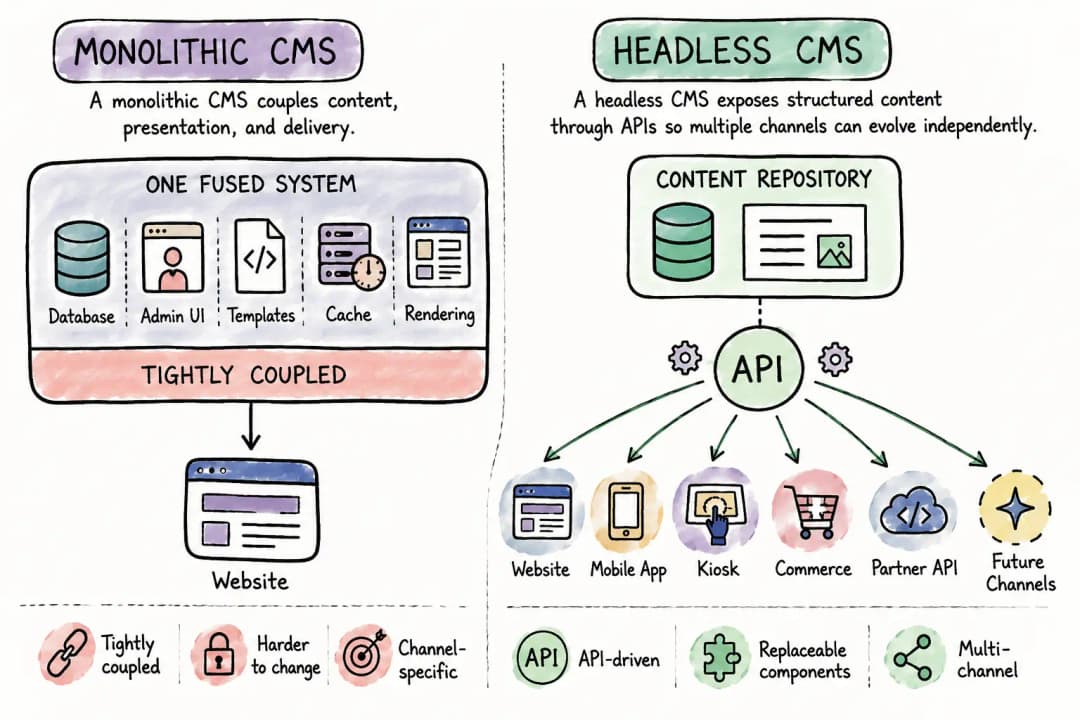 traditional cms vs. headless cms
Channel fragmentation
A traditional CMS was designed primarily to publish webpages. Modern organisations often need the same content to appear across websites, mobile applications, ecommerce experiences, account portals, in-store displays, knowledge bases, partner integrations, and emerging AI interfaces.
With a headless CMS, content can be created once as structured data and reused across multiple channels. This avoids the operational burden of maintaining duplicate content in separate systems and supports a more consistent brand experience.
Vendor lock-in and redesign risk
Monolithic systems can also make redesigns more expensive than they should be. If the content model and frontend presentation are deeply tied together, a replatforming project can become a content migration, template rebuild, infrastructure change, and visual redesign all at once.
Monolithic decoupling reduces this scope. A company can redesign its web experience, adopt a new frontend framework, or add another channel while retaining the underlying content repository and governance model. That does not eliminate migration work, but it can make change more modular and less disruptive.
Page Speed: Where Infrastructure Meets Revenue
Page speed is one of the most commercially relevant headless CMS benefits, although it needs to be discussed precisely.
Headless architecture does not make a website fast by default. A poorly designed React application can still be slow. However, headless CMS gives teams more control over the frontend and delivery architecture, which can create better conditions for performance work.
A decoupled frontend can use static generation, server-side rendering, partial rendering, edge caching, image optimisation, and modern frontend frameworks without being limited by a CMS template layer. The public site can be optimised for its specific experience, while the CMS remains focused on content operations.
How headless supports page speed
Static generation and CDN delivery
Content-driven pages can be pre-rendered and served from CDN edge locations. This can reduce the work required to assemble a page at request time and improve the consistency of delivery for users in different regions.
Independent caching
In a decoupled architecture, teams can separately cache API responses, static assets, images, and dynamic application functions. A small content update does not need to invalidate every element of the site.
Frontend freedom
Teams can select technologies and rendering patterns that suit their performance requirements instead of working within a proprietary templating system. Headless CMS platforms are designed to support frontend framework flexibility and API-based delivery.
Less plugin-driven overhead
In many legacy CMS implementations, years of plugin additions, template modifications, and third-party scripts create performance debt. Moving to headless does not remove every third-party dependency, but it gives teams a clearer opportunity to rebuild the public experience with performance budgets and component-level control.
For technical teams, the goal should be measurable: improve Core Web Vitals such as Largest Contentful Paint, Interaction to Next Paint, and Cumulative Layout Shift.
For commercial leaders, the point is simpler: a faster, more stable experience reduces avoidable friction before a customer can read, browse, register, or buy something.
Conversion Rate: The Board-Level Metric
Conversion rate is where infrastructure becomes commercial. A high-performing digital experience removes barriers between intent and action. If pages load quickly, product information is current, checkout flows are stable, and campaign content reaches the right audience at the right time, a business is better positioned to convert demand that it has already paid to acquire.
The benefits of headless CMS contribute to this outcome through three main mechanisms
1. Performance-driven retention
A performance-focused frontend can reduce unnecessary client-side work, improve rendering speed, and make navigation feel more immediate. Headless CMS gives frontend teams the flexibility to optimise independently, using static delivery, caching, and tailored rendering strategies.
2. Faster experimentation
Conversion optimisation depends on learning. Teams need to test offers, calls to action, page structures, product messaging, and audience-specific content without turning every experiment into a major release.
A headless CMS supports structured content variants and API-driven delivery. Editors can prepare approved content in a few clicks, while developers build reusable components and experimentation logic. This can shorten the time between an insight and a live experiment.
3. More relevant content operations
Conversion rate is also influenced by relevance. Seasonal promotions, regional messages, product availability, and campaign landing pages lose value when they are delayed by a publishing bottleneck.
When content and frontend delivery are separated, editorial teams can often update content independently within established governance rules. Developers can focus on improving the experience rather than manually implementing every copy or campaign update. Faster content workflows are a recognised advantage of headless content systems.
The board-level question is not, “Will a headless CMS add two points to our conversion rate?” No responsible team should promise that without evidence from its own analytics.
The better question is: what revenue is currently constrained by slow performance, slow publishing, weak experimentation, or fragmented content operations?
Digital Scaling: What Growth Actually Requires
Digital scaling is often used as a vague promise. In practical terms, it means the ability to add channels, markets, languages, products, and teams without increasing complexity at the same rate.
A business may start with one website. Over time, it adds regional sites, a customer portal, a mobile app, product content, support journeys, localisation workflows, partner experiences, and more. If every expansion requires a new CMS instance, custom templates, duplicated content, and a separate deployment process, growth becomes operationally expensive.
Headless CMS changes this model by treating content as a reusable service. Monolithic systems do not scale well in this sense. Adding a new channel typically means extending the CMS through plugins, custom modules, or separate integrations that each introduce their own maintenance burden.
Adding a new market often means a new CMS installation, a new theme, a new deployment pipeline. Adding a new language requires either a multisite setup with its own operational complexity or a translation plugin that layers onto a fragile architecture.
Key CMS Trends That Widen the Gap
AI-assisted authoring with governance
CMS platforms are increasingly adding AI capabilities for drafting, editing, tagging, summarising, localisation support, and metadata generation. The important development is not simply AI-generated text. It is the governance layer around it: approvals, brand rules, permissions, auditability, and human review.
Personalisation at the content layer
Personalisation is moving beyond frontend-only logic. Structured content variants, audience rules, and API delivery allow teams to prepare experiences for different regions, segments, devices, and lifecycle stages. The challenge will be maintaining governance and avoiding an unmanageable number of content variants.
Component-driven visual editing
As component-based frontends become standard, visual editing is being rebuilt around design-system components rather than unrestricted WYSIWYG pages. This creates a clearer bridge between what editors assemble and what engineering teams can support reliably.
Content federation
Large organisations rarely operate a single source of truth for every kind of content. Product data, digital assets, customer data, knowledge content, and campaign content may live in different platforms. Content federation and unified content APIs will become increasingly important for assembling relevant experiences without duplicating data.
Composable stacks with clearer accountability
Composable architecture will continue to grow, but so will the need for ownership. The future is not a collection of disconnected SaaS tools. It is a deliberate architecture with documented integrations, clear data contracts, monitoring, security controls, and accountable owners.
Stronger governance and compliance
As organisations scale content operations across regions and teams, governance becomes a procurement requirement. Role-based access, approval flows, audit trails, content expiry, accessibility checks, and localisation controls are becoming core CMS capabilities rather than optional extras.
Headless CMS for AI-ready content
Structured content is easier to reuse not only across human-facing channels, but also across AI-powered interfaces. Organisations that treat content as structured, governed data will be better positioned to power search, recommendation systems, assistants, and future conversational experiences.
Multi-channel delivery
An API-first content repository can serve multiple frontend applications. The same product description, campaign message, support article, or location record can be adapted for web, mobile, commerce, and partner channels without copying the underlying information into each system.
Market expansion without duplication
Global expansion creates more than translation work. It introduces local pricing, regulatory requirements, regional campaigns, market-specific content, and brand governance challenges.
A structured headless CMS can model these differences at the content level. Instead of cloning an entire site for every market, teams can use locales, reusable modules, permissions, and localisation workflows within a central content operation. The actual benefit depends on content modelling and governance, but the architecture is designed for reuse at scale.
Composable technology choices
Headless CMS also fits into a composable architecture. Rather than relying on a single platform for content, commerce, search, personalisation, authentication, analytics, and delivery, organisations can connect specialised services through APIs.
This approach has trade-offs. More services can mean more integration work and governance requirements. But it also allows teams to replace or upgrade one capability without forcing a full-platform replacement. API-first integrations are a central advantage of headless CMS platforms.
Parallel delivery teams
Digital scaling is ultimately constrained by the speed at which teams can make safe changes. In a decoupled model, frontend developers, backend engineers, content editors, designers, and marketers can work in parallel against shared contracts: content models, components, APIs, and governance rules.
That is one of the most durable benefits of headless CMS. It creates an operating model in which content and technology teams are less likely to block each other.
How to Evaluate Whether Headless CMS Is Right for Your Business
- Map your current channels, markets, and content workflows.
- Identify performance, deployment, and publishing bottlenecks.
- Define the content model and governance requirements.
- Choose an implementation and migration approach.
- Measure outcomes through Core Web Vitals, release velocity, content reuse, and conversion metrics.
Why Do Enterprises Treat Headless CMS as Infrastructure?
The headless CMS benefits that matter most are not technical abstractions. They are practical business advantages:
-
Launch new markets without rebuilding the full website
-
Redesign the frontend without migrating all content
-
Publish time-sensitive commercial content without waiting for an engineering release
-
Deliver web, mobile, commerce, and partner experiences from a shared content foundation
-
Improve digital performance through independent frontend optimisation
-
Reduce the operational drag created by tightly coupled legacy systems
For a company with a single marketing site and a limited growth roadmap, headless may add unnecessary cost and complexity. A traditional CMS or hybrid approach can be the better choice. Headless implementations typically require more frontend development, clearer content modelling, and stronger coordination between technical and editorial teams.
For a business operating across markets, brands, languages, products, or customer touchpoints, the calculation changes. The cost of staying coupled can grow faster than the cost of decoupling.
That is why headless CMS has moved from developer blogs to CFO dashboards and board-level roadmaps. It is not simply about adopting a modern stack. It is about setting a higher ceiling for digital operations.
FocusReactive Perspective
As a headless cms development company, FocusReactive see headless CMS as a strategic foundation. The important decision is not simply whether to choose Sanity, Storyblok, or Payload CMS. We help teams select and implement an architecture that reflects their real needs: content complexity, editorial workflow, market structure, frontend stack, governance model, ownership preferences, and growth roadmap.
Each platform makes different trade-offs:
| Platform | Strong fit | Primary advantage |
|---|---|---|
| Sanity | Highly structured, relationship-heavy content | Flexible schemas and detailed control over content queries |
| Storyblok | Visual page composition and editor autonomy | Component-based visual editing |
| Contentful | Enterprise content operations and governance | Mature ecosystem and workflow capabilities |
| Payload CMS | Code-first TypeScript teams | Application-level ownership and developer-led customisation |
If you would prefer an experienced team to lead the process, FocusReactive delivers headless CMS migrations for organisations moving away from WordPress, Drupal, Sitecore, Webflow, HubSpot CMS, and other monolithic or tightly coupled platforms. We help teams evaluate the right target architecture, migrate structured content, preserve SEO-critical elements, and build high-performance frontends with platforms such as Sanity, Storyblok, Contentful, and Payload CMS.
We also support post-launch monitoring to identify performance regressions, indexing issues, content gaps, and technical SEO risks as the new platform settles into production.