

For over a decade, WordPress’s dominance over the web was a universally accepted truth—its market share only ever went up. But 2026 marked a historic tipping point. For the first time, the undisputed king of the internet is losing its crown.
After two straight years of declining market share, a record-breaking avalanche of plugin vulnerabilities, and a year marred by boardroom drama and courtroom battles, the narrative has shifted. Today, the conversation isn’t about how to build on WordPress; it’s about how to get off it.
Teams abandoning the platform are reporting massive, measurable wins: lightning-fast load times, slashed hosting bills, and newfound editorial freedom. But escaping the ecosystem isn’t without risk. Botched migrations can tank SEO rankings, break redirects, and leave teams untangling thousands of pages of plugin-bloated code.
Drawing on market-share tracking from W3Techs, BuiltWith, and HTTP Archive, security data from Patchstack, and real-world migration case studies, this report breaks down exactly where WordPress stands in 2026—and what leaving it actually entails.
(Note: If you cite this data in your own article or report, please credit this research and add a backlink to our site.)
The TL;DR: Top Migration Statistics for 2026
- The Historic Decline: As of November 2026, WordPress powers 39.5% of the web, down from 43.6% in January 2025. That’s a massive 9% loss of its total footprint in under two years (1, 2).
- A Security Nightmare: 2025 saw a staggering 11,334 new vulnerabilities in the WordPress ecosystem (a 42% YoY increase). A shocking 91% were found in plugins. Only 6 were in the core (12).
- The 5-Hour Window: When a severe WordPress vulnerability drops, the weighted median time before mass exploitation begins is just 5 hours (12).
- The Performance Gap: WordPress is dead last among major CMS platforms for Core Web Vitals. Only 45–46% of WordPress sites pass on mobile, compared to 85% for Duda and 74–75% for Wix (4, 13).
- E-commerce Tides Turn: WooCommerce is bleeding users to Shopify. WooCommerce lost roughly 76,000 sites in a year, while Shopify gained 52,000 (36).
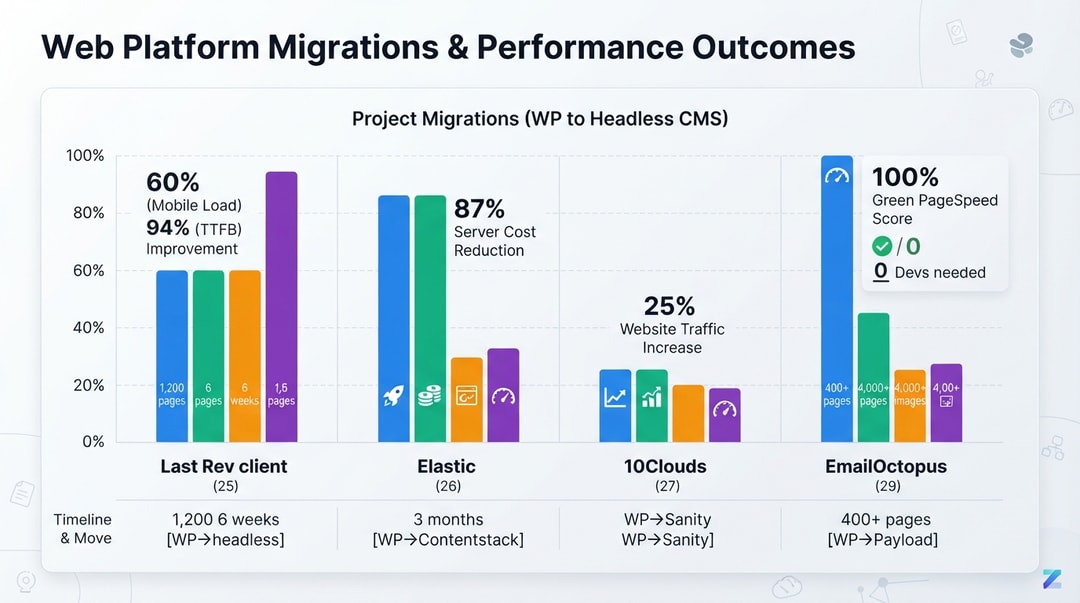
- The Cost of Leaving vs. Staying: Elastic cut their server costs by an incredible 87% after migrating away from WordPress (26). Meanwhile, a documented 1,200-page WordPress-to-headless migration cut mobile load times by 60% (25).
- The AI Revolution: Migrations no longer take years. Using AI-assisted pipelines, FocusReactive moved 16,500 pages in just 8 weeks with zero URL changes (32).
The Slow Slide: WordPress Market Share in 2026
It’s hard to overstate how unprecedented this is. For years, WordPress was the default choice for the web. But W3Techs data reveals six consecutive months of decline from December 2025 to May 2026, a drop that only accelerated over the summer (2, 3).
Table 1: WordPress Share of All Websites (W3Techs)
| Date | Share of all websites | Source |
|---|---|---|
| January 2025 | 43.6% | (2) |
| October 2025 | 43.3% | (2) |
| December 2025 | 43.2% | (2) |
| May 27, 2026 | 41.9% | (2) |
| September 10, 2026 | 40.3% | (6) |
| September 29, 2026 | 40.2% | (3) |
| November 2, 2026 | 39.5% | (1) |
Who is stealing the crown? Between May 2025 and May 2026, Wix gained 0.6 points, Shopify 0.4, Squarespace 0.2, and Webflow 0.1. Developer attention is also shifting rapidly: monthly downloads for the Astro framework doubled from 4.59 million to 9.24 million in early 2026 (2).
Even more telling is the “Long Tail of Exits.” BuiltWith has detected 87.8 million websites using WordPress over time, but only 36.5 million are still live today (5).
The Push Factors: Why Are Teams Finally Leaving?
Enterprises don’t undergo the headache of a platform migration on a whim. They leave because the technical debt, security anxiety, and slow page loads simply become too expensive to ignore. Add in 2026’s explosive governance drama, and the exit doors are crowded.
1. The Plugin Security Problem
WordPress core is relatively safe, but its plugin ecosystem is a hacker’s playground. Highly exploitable vulnerabilities grew by 113% YoY. If you think paying for premium plugins buys you safety, think again: premium components accounted for 29% of valid reports and had three times as many exploited vulnerabilities as free ones (12).
2. The Tech Debt Timebomb (Outdated PHP)
Over 70% of publicly reachable WordPress sites are running outdated PHP. Shockingly, PHP 7.4—which reached end-of-life in November 2022—is still the single most common version powering WordPress sites today (35). With WordPress 7.0 forcing a minimum PHP of 7.4.0 (10), sites that skipped server upgrades are facing a forced migration of their own.
3. Core Web Vitals: Dead Last
In the modern web, speed is revenue. Yet, WordPress ranks sixth out of six major platforms on Core Web Vitals.
Table 2: Core Web Vitals Mobile Pass Rates (HTTP Archive, Nov 2025)
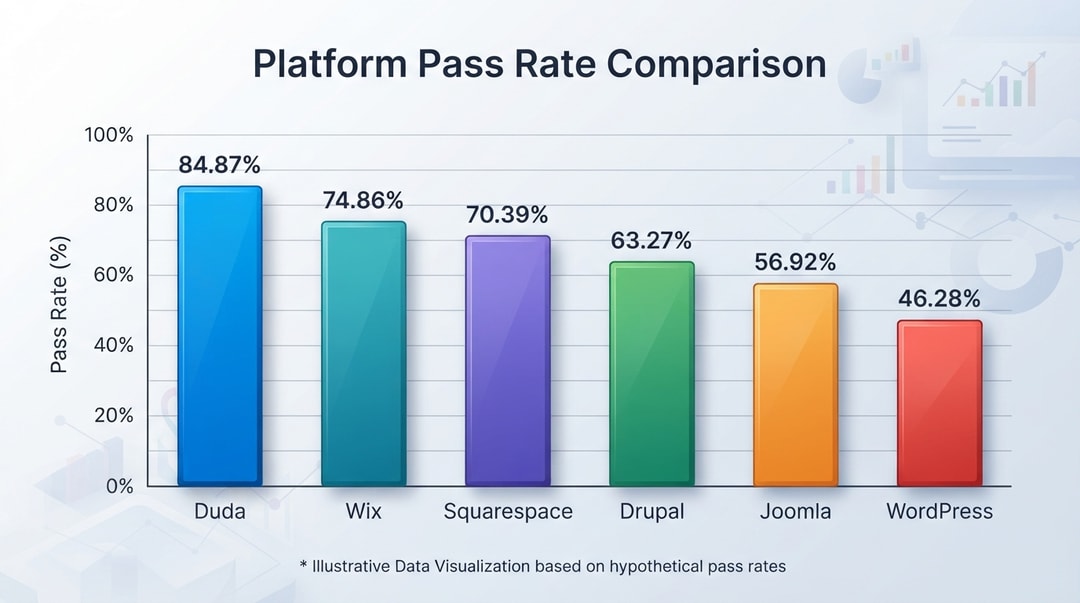 Timelines and Cost
(Source: HTTP Archive, via Search Engine Journal (13))
4. The Governance Drama
If the tech wasn’t enough to scare off enterprise users, the politics certainly did. Between 2025 and 2026, Automattic drastically cut its sponsored core contributions (7, 8), court battles flared with WP Engine (9), and CEO Matt Mullenweg was briefly placed on paid leave during a board shake-up (6). The flagship WordPress 7.0 release was delayed, and its headline real-time collaboration feature was slashed just 12 days before launch (10, 11).
The E-commerce Exit: Shopify Catches WooCommerce
Store owners are fleeing WordPress faster than anyone else. WooCommerce’s once-dominant 2:1 lead over Shopify has drastically shrunk to 1.26:1 (36).
Table 4: Share of All Crawled Sites (HTTP Archive)
 WordPress Migration
Shopify is dominating the upper echelon of e-commerce. Among the top 10,000 sites, Shopify is used 4.5 times more often than WooCommerce (36).
The Pull Factors: The Headless & Composable Boom
Where are marketing teams going? Straight into headless and composable architectures. According to WP Engine (ironically, the largest WordPress host), 73% of surveyed businesses already use a headless architecture. Of those who switched, an overwhelming 99% report measurable improvements (16, 14).
The Cost Motivation:
- Infrastructure: Elastic paid an average of $7,000/month in server costs on WordPress. After moving to a headless setup, that dropped to $890/month—an 87% reduction (26).
- Talent: Developers with modern headless CMS skills command 29% higher salaries than those with legacy CMS skills. For marketers, that gap jumps to 85% (15).
(Note: “Headless WordPress” remains a niche middle ground. WPGraphQL has around 30,000 active installs (38), a tiny drop in the ocean of 36.5 million live WP sites. For most, headless WP is just a stepping stone to a full exit.)
The Elephant in the Room: SEO and Migration Traps
If the grass is so much greener, why doesn’t everyone migrate tomorrow? SEO fear.
Data proves this fear is justified. Across 892 domain migrations, organic traffic took an average of 523 days to return to pre-migration levels. Brutally, 17% of sites never recovered (17).
The main culprit? Shortcodes, messy page-builder markup, and broken redirects. Furthermore, migrating to a poorly configured client-rendered front end can blindside AI bots. Neither GPTBot nor ClaudeBot execute JavaScript properly (41). If you move off WordPress (which renders on the server) to a badly built client-side app, you essentially erase your brand from AI-generated search answers.
AI to the Rescue: Shrinking the Timeline
Manual migrations are a copy-paste nightmare. A 1,000-page WordPress blog requires roughly 250–750 hours of tedious manual labor (24).
But in 2026, AI has completely changed the math.
WordPress migrations are highly predictable, making them a perfect fit for programmatic AI pipelines. In one 1,200-page migration to headless, 94.3% of pages were migrated entirely via script. Only 5.7% required a human touch (25).
FocusReactive recently utilized AI-assisted pipelines to migrate 16,500 pages in just 8 weeks using a single engineer, maintaining 100% URL parity (32). Today, AI tools can literally take a live WordPress URL and spin up a ready-to-run Next.js project with seeded content and a mapped CMS schema (33).
Table 3: Real-World Migration Results
| Project | Move | Scale and timeline | Key results |
|---|---|---|---|
| Last Rev client (25) | WP → headless | 1,200 pages; 6 weeks | Mobile load 4.8s → 1.9s (-60%), TTFB -94% |
| Elastic (26) | WP → Contentstack | 3 months | Server costs -87% ($7k → $890/mo) |
| 10Clouds (27) | WP → Sanity | — | Website traffic +25% |
| EmailOctopus (29) | WP → Payload (by FocusReactive) | 400+ pages, 4,000+ images | 100% green PageSpeed, 0 devs needed for content |
The Verdict for 2026
WordPress isn’t dying tomorrow. It still powers nearly four in ten websites, and version 7.0 lays promising groundwork for built-in AI tools (10).
But the era of “WordPress by default” is officially over. The data clearly shows a steady exodus driven by compounding security risks, dismal performance metrics, and a turbulent governance structure.
If you are planning an exit in 2026, remember the golden rules: Audit your plugins first, finalize your redirect map in week one, and let AI automate the repetitive 90%.
(Planning a move? FocusReactive runs AI-assisted migrations to Payload, Sanity and Storyblok. We utilize a verification harness that checks every single page against your live site, ensuring zero SEO drift. Get a scoped proposal in two days, not two months.)
Full List of References & Sources
WordPress market share and ecosystem
- W3Techs, “Usage statistics and market share of WordPress” (November 2026) — w3techs.com
- Search Engine Journal, “WordPress Market Share Declines For Six Months In A Row” — searchenginejournal.com
- Axis Intelligence, “WordPress Statistics 2026” (W3Techs snapshot, September 29, 2026) — axis-intelligence.com
- HTTP Archive, “Web Almanac 2025: CMS” — almanac.httparchive.org
- BuiltWith, “WordPress Usage Statistics” — trends.builtwith.com
- CMSWire, “WordPress.com Founder Mullenweg Put on Leave by Board” — cmswire.com
- TechCrunch, “Automattic says it will reduce its contribution to WordPress core project” — techcrunch.com
- TechCrunch, “Automattic says it will start contributing to WordPress again after pause” — techcrunch.com
- eSEOspace, “The WP Engine and Automattic Dispute Explained (October 2026)” — eseospace.com
- DreamHost, “WordPress 7.0: What’s New in Armstrong (And What Got Cut)” — dreamhost.com
- Search Engine Journal, “WordPress 7.0 Will Ship Without Real-Time Collaboration” — searchenginejournal.com
Security and performance
- Patchstack, “State of WordPress Security in 2026” — patchstack.com
- Search Engine Journal, “Core Web Vitals Champ: Open Source Versus Proprietary Platforms” — searchenginejournal.com
CMS surveys
- Storyblok, “State of CMS 2024” — storyblok.com
- Storyblok, “State of CMS 2025” press release — storyblok.com
- WP Engine, “The State of Headless 2024” — wpengine.com
Migration timelines, costs and SEO
- Search Engine Journal (Dan Taylor), “How Long Should An SEO Migration Take? [Study Updated]” — searchenginejournal.com
- Google Search Central, “Site Moves and Migrations” — developers.google.com
- Core dna, “CMS Migration Timeline: How Long Does It Take?” — coredna.com
- FocusReactive, “How to Migrate WordPress Site to Headless CMS in 2026” — focusreactive.com
- FocusReactive, “Migrate from WordPress to Headless CMS” — focusreactive.com
- DesignRush (Standish Group CHAOS Report), “Only 31% of Projects Succeed On Time and On Budget” — designrush.com
- McKinsey, “Delivering large-scale IT projects on time, on budget, and on value” — mckinsey.com
- Oshyn, “How much time will content migration take?” — oshyn.com
Case studies
- Last Rev, “WordPress to Headless CMS: 50% Faster Load Times” — lastrev.com
- Contentstack, “Elastic switches WordPress for headless solution” — contentstack.com
- Sanity, “Why 10Clouds moved from WordPress to Jamstack with Sanity” — sanity.io
- Multidots, “Foursquare case study” — multidots.com
- FocusReactive, “EmailOctopus case study” — focusreactive.com
AI-assisted migration
- Payload, “How to migrate from WordPress to Payload” — payloadcms.com
- FocusReactive, “AI in Web Development & CMS Migration Statistics 2026” — focusreactive.com
- FocusReactive, “AI Website Migration from a Single URL” — focusreactive.com
- FocusReactive, “50+ Headless CMS Migration Statistics in 2026” — focusreactive.com
E-commerce, PHP, headless WordPress and AI crawlers
- Censys, “Why Are WordPress Sites Still Running EOL PHP?” — censys.com
- Barn2, “Shopify vs WooCommerce Market Share: Who’s Really Winning?” (HTTP Archive and W3Techs data) — barn2.com
- W3Techs, “Usage statistics and market share of Shopify” (November 2026) — w3techs.com
- WordPress.org, “WPGraphQL” plugin page — wordpress.org
- WordPress.org, “Faust.js” plugin page — wordpress.org
- Search Engine Roundtable, “Poll: 80% Of SEOs Expect Some Traffic Loss After Site Migration” — seroundtable.com
- Vercel, “The rise of the AI crawler” — vercel.com
- Ahrefs, “301 Redirects Explained: How They Impact SEO” — ahrefs.com